A black-and-white photograph of a large formation of Lebanese Army soldiers marching in tight unison during a drill. The soldiers are dressed in matching uniforms and combat boots, wearing distinctive helmets with integrated ear and chin protection, holding rifles diagonally across their chests. In the background, a war-torn urban landscape features large mounds of dirt and rubble in front of a heavily damaged, multi-story apartment complex and a smaller white building marked with bullet holes.

With a backdrop of rubble and war-damaged buildings, Lebanese Army soldiers conduct a precision marching drill in Beirut. American Marine forces are training Lebanese army regulars in rapid deployment techniques. Lebanon. December 21, 1982. (AP Photo/Paola Crociani)

Arming the State Against the Nation: The Illusion of a Military Solution in Lebanon

Editor’s Note: Unless otherwise indicated, details and arguments on the Lebanese army are drawn from the author’s primary research and his recently published book Les Soldats et l’Etat dans le Liban en Guerre (Presses Universitaires de France, 2025). 

The black dots (●) in the text are clickable to display documents sourced in this article.

On March 2, 2026, Lebanese Prime Minister Nawaf Salam declared Hezbollah’s military activities illegal and called on “the military and security agencies to take immediate measures” to consolidate all arms under state authority.1 The decision marked a new phase in the disarmament plan approved by Salam’s cabinet in September 2025 and the clearest attempt to shift away from the doctrine of “the army, the people, and the resistance.”

First formalized under Syrian tutelage in the 1992 ministerial statement of Prime Minister Rafiq al-Hariri, the doctrine framed Lebanon’s defense policy as a division of labor: the Lebanese Armed Forces (LAF) were tasked with maintaining internal order and mediating between political rivals — a continuation of the LAF’s traditional role since their creation in 1945 — while the mission of liberating southern Lebanon from Israeli occupation and deterring future invasions was entrusted to Hezbollah.2

Despite internal pressure from politicians and media outlets such as MTV Lebanon, as well as the U.S. threat to suspend assistance to the Lebanese army, the disarmament plan has largely stalled since the March 2 cabinet decision. During a heated exchange with the prime minister, LAF Commander Rodolphe Haykal reportedly refused to engage his troops in a direct confrontation with Hezbollah. This refusal echoes General Fouad Chehab’s cautious stance during the 1958 civil strife, when the first army commander resisted President Camille Chamoun’s order to crush the opposition for fear of splitting the military along political and sectarian lines. Instead, combat units were only used to contain the uprising and secure the main roads and centers of power.3 General Haykal’s reaction should also be read in light of the tragic result of other LAF interventions against domestic actors. The use of force advocated by Salam’s cabinet is indeed reminiscent of key moments from the history of post-independence Lebanon, when the country was riven by civil strife and war, and the idea of deploying the military to “restore order” found broad appeal. These critical junctures hold the key to understanding both the dangers of such a military approach and the flaws of the debate over the monopoly on arms and the weakness of the Lebanese army.

Lessons From the February 6 Uprising

In both 1975-1976 and 1983-1984, two of the deadliest episodes of the Lebanese Civil War, Lebanese Presidents Suleiman Frangieh (r. 1970-1976) and Amine Gemayel (r. 1982-1988) turned to the army to quell the opposition and bring an end to the conflict. They precipitated instead the division of the military institution along political, sectarian, and territorial lines. Of the two episodes, the crisis of 1983-1984 offers the more revealing comparison with the current situation in Lebanon, sharing at least three important features with the ongoing debate over Hezbollah’s disarmament.

“The army, the people, and the resistance” doctrine framed Lebanon’s defense policy as a division of labor: the Lebanese Armed Forces were tasked with maintaining internal order and mediating between political rivals, while the mission of liberating southern Lebanon from Israeli occupation and deterring future invasions was entrusted to Hezbollah.

First, any military confrontation with Hezbollah would require the deployment of the majority of the LAF’s combat personnel. The closest historical precedent for using the army on such a mass scale — proportionate to its actual size — against internal opposition forces remains the army’s campaign against the Amal Movement and the Progressive Socialist Party (PSP) between August 1983 and February 1984. While some would point to the LAF confrontations with the Lebanese Forces in 1989 and 1990 as another example, the military institution then was already divided and could not mobilize more than one-fifth of its combat units. As for the period between May 1975 and January 1976, combat units were only deployed piecemeal across the country to support the Kataeb Party and its Christian right-wing allies against the Lebanese Left and the Palestinian factions.

A second similarity lies in the perception that the balance of power favors a forced disarmament. Between 2023 and 2025, Israel and the United States inflicted severe and unprecedented setbacks on the Axis of Resistance, of which Hezbollah is a part. This led many, including U.S. officials and President Joseph Aoun himself, to conclude that Hezbollah had been militarily broken. This assessment has proven wrong, as Hezbollah has managed to rebuild some of its capabilities, in preparation for a war of attrition. A comparable sense of opportunity followed Israel’s 1982 invasion of Lebanon. The Lebanese National Movement (LNM), a coalition of leftist and Arab nationalist parties, emerged badly weakened. And after imposing an extremely harsh siege on West Beirut, Israeli occupation forces expelled the Palestinian combatants — al-fidā’iyyīn — depriving the LNM of its ally and main source of funding and military support. In the wake of this geopolitical earthquake, the newly elected president, Amine Gemayel, deemed the moment ripe to revive the Lebanon of the 1943 National Pact, with its Maronite dominance and politics of notables.4

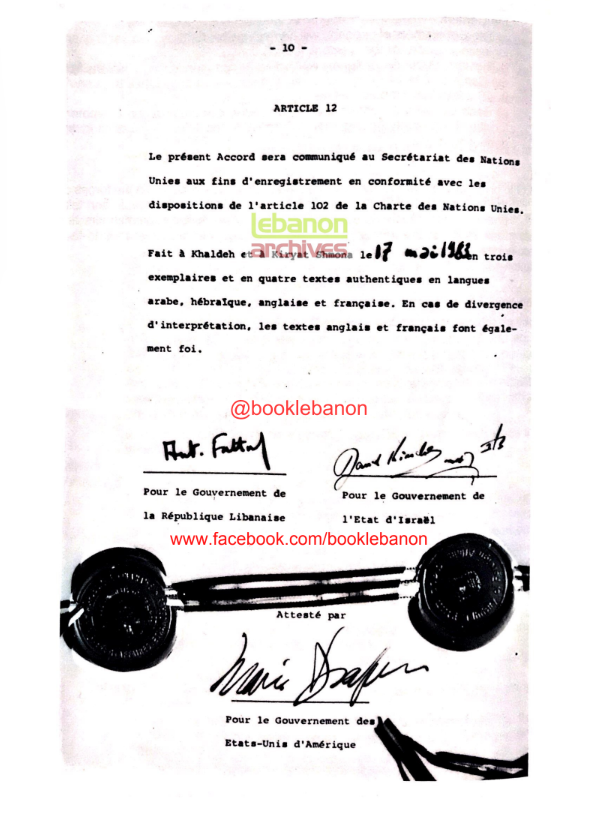
Finally, as today, the Lebanese government was backed by the United States. In the early fall of 1982, Washington saw the Israeli-bayoneted removal of the Palestine Liberation Organization (PLO) as a golden opportunity to impose a pro-Western Lebanese government willing to normalize relations with Israel. Between December 1982 and May 1983, Lebanese and Israeli delegations participated in several rounds of U.S.-brokered negotiations. Their talks resulted in the stillborn agreement of May 17, 1983[note:1], which stipulated the end of the state of war between Lebanon and Israel while including several “security arrangements” that severely infringed on Lebanese sovereignty.5 The agreement was nonetheless approved by both the cabinet and Parliament, but Amine Gemayel refrained from ratifying it because of a side letter the Israeli delegation had addressed to the American mediator, Morris Draper, on the eve of its signing. Dated May 17, the letter introduced a new, deliberately unattainable clause into the negotiations: it conditioned Israel’s withdrawal on a prior Syrian withdrawal — giving Damascus an effective veto over the agreement. Israel also reserved the unilateral right to pull out of the agreement if the condition was not met. Unable to obtain sufficient U.S. guarantees for its implementation, Gemayel eventually bowed to pressure from Syria and a broad, multi-sectarian coalition of Lebanese parties and leaders and renounced the May 17 agreement in March 1984. 

President Ronald Reagan stands at a wooden podium speaking during an outdoor event on October 19, 1982. He is wearing a dark brown pinstripe suit and a striped tie. Behind him to the left, a US military honor guard member stands at attention holding the American flag. To the right, Lebanese President Amin Gemayel stands smiling in a gray double-breasted suit while holding a black folder. On the far right, another military honor guard member holds the Lebanese flag against a backdrop of lush green trees.

President Reagan making a departure statement after visiting with President of Lebanon Amin Gemayel outside the oval office. October 19, 1982. (Image Credit: Reagan Library Archives)

A similar pattern is unfolding today. In April 2026, Lebanon and Israel reached an understanding granting Israel the right to continually violate Lebanese sovereignty, followed by lopsided Washington negotiations. The resulting U.S.-brokered agreement, signed on June 26, once again fails to guarantee Israeli withdrawal, instead legitimizing continued occupation until “non-state armed groups are successfully disarmed.” In doing so, it severely constrains Lebanon’s foreign policy by preventing the Lebanese authorities from pursuing accountability for Israeli war crimes and threatens to engulf the country in civil war by setting the Lebanese Armed Forces against Hezbollah. 

Disclosed a few days after its signing, the “Security Annex” to the June 26 framework agreement effectively places Lebanon’s sovereignty in the region south of the Litani River under the strict supervision of the “Military Coordination Group for Lebanon.” Endowed with broad and vaguely defined prerogatives and comprising Lebanon, Israel, and the United States, this body recalls the “Security Arrangements Committee” established under the May 17 agreement to oversee — and restrict — the deployment, composition, and mission of the Lebanese army in south Lebanon. Under the new arrangement, the LAF are tasked with collaborating with the Israeli army to disarm a component of Lebanese society, without a fixed timeline for the end of Israeli occupation. 

The U.S.-sponsored normalization process of 1983 hinged on the LAF as its cornerstone. In January of that year, the Lebanese Army Modernization Program, designed by an American military team, began to be implemented. The United States poured military equipment into the LAF, much of it paid in cash by the Lebanese state. More than 10,000 men (one-third of the army’s total strength and two-thirds of its combatants) from infantry, artillery, and armored units underwent intensive training at the hands of the U.S. Marines and Special Forces.

Assisted by France, the United States sought to strengthen Lebanon’s military — without threatening Israel’s military superiority — officially to help the government restore its authority over Lebanese territory. With this training program, the LAF reached, arguably, a historical peak in terms of combat preparedness and equipment. So, what happened?

In the picture above, soldiers gather in a circle around two men wrestling with one another. In the picture below, a military man standing tall, his hands tightened around a rope, as another man descends with the other end of the rope tied around his waist.

U.S. Special Forces (Green Berets) are training members of the Airborne Battalion (created in 1982) of the Lebanese army on one-on-one combat and troop landing with ropes, or fast-roping. Top image in Al-Raml al-Aaali, Bourj al-Barajneh, Beirut. Bottom image, possibly near the Ministry of Defense in Yarzeh, Baabda. Between January or February 1983. (Photograph published in the Lebanese Armed Forces’ monthly periodical Al-Jundi al-Lubnani, February 1983, p. 10)

In early February 1984, President Gemayel sent army units to fight the Amal Movement and the Progressive Socialist Party. Alongside smaller groups of the defunct LNM, these opposition forces were organizing an uprising to regain control of West Beirut. Amal and the PSP received military equipment from Syria and were assisted by a group of Lebanese junior officers who had formed a Free Officers’ movement (harakat dubbāt ahrār) to oppose both normalization with Israel and the restoration of Christian dominance.

What followed became known as the “February 6 Uprising” (intifādat 6 shubāt) and marked the victory of the opposition over Gemayel and his American patron. U.S. troops, whose presence had already been undermined by the suicide bombing of the Marine barracks on October 23, 1983, completed their withdrawal from Lebanon by the end of February 1984. The May 17 agreement was abrogated by Parliament the following month, and a “national unity” government was formed in April, which de facto ended Christian dominance of the political system and sanctioned the fragmentation of Lebanon into militia cantons. Reflecting the state of the country, the army split into regional, semi-autonomous brigades in the weeks that followed the February 6 Uprising.

Two factors account for the fragmentation of the military institution. The first is political. Defectors, predominantly Muslim, sympathized with the cause defended by the PSP and the Amal Movement, which, like the Free Officers, fought for a new political system and rejected the May 17 agreement. The second factor, equally, if not more important, is territorial. Although many of the defecting soldiers had grown disenchanted with Gemayel’s rule, they were as appalled by militias — including the PSP and Amal — and the economy of predation they imposed on the Lebanese population. They nonetheless defected before or after the opposition’s victory. Some could simply not shoot on their community members.

The Lebanese Army Modernization Program, designed by an American military team, began to be implemented in January 1983. The United States poured military equipment into the LAF, much of it paid in cash by the Lebanese state. More than 10,000 men, from infantry, artillery, and armored units, underwent intensive training at the hands of the U.S. Marines and Special Forces.

A former Shia soldier who returned to the barracks in early February 1984 recalls: “We were supposed to shoot at an area called Hay el-Sellom. But I used to live there — my relatives, my neighbors… Impossible to fire on my own people!”6 When it was not a direct encounter that pushed them to abandon their positions, it was the soldiers’ desire to be able to come home, most of them hailing from rural towns and villages. How does one return to their village after spilling the blood of their neighbor, or if the village is controlled by the opposing side?

Civil strife is a very intimate type of warfare — especially in Lebanon’s tightly knit social fabric, where the sectarian system entwines political and local affiliations. The relationships of everyday life can erode the coercive power on which a military institution — and, indeed, every institution — relies. Today, Shia soldiers account for roughly one-third of the troops, while the majority of the rank-and-file soldiers come from rural backgrounds, meaning that they retain strong ties to their ancestral villages.7 The prospect of deploying the army against Hezbollah therefore amounts to imposing an insurmountable choice on all these men and women who cherish their quotidian social networks.

The False Neutrality of the State

Despite the lessons that can be drawn from the February 6 Uprising, former President Amine Gemayel recently urged his distant successor Joseph Aoun and the prime minister to “see the negotiations with Israel through.” Gemayel is among the voices calling on the army to disarm Hezbollah. Those who do so often invoke — or hide behind — an apparel to state neutrality. In their view, the state stands above all parties and, therefore, should hold the monopoly on violence to guarantee civil peace.

This syllogism draws on what Timothy Mitchell has aptly called the “state effect”: a set of practices through which the state is perceived as distinct from society.8 By virtue of the state effect, calling for the disarmament of Hezbollah appears as an apolitical claim and allows those making such a claim to pose as mere defenders of state sovereignty. Some of those defenders go further to justify a military confrontation by portraying Hezbollah as an Iranian proxy — a bare “excrescence of the Islamic Republic” that does not belong to, or has excluded itself from, the Lebanese body politic. This rhetoric is typical of a civil war ethos, which necessitates the excommunication of the other from the national community to legitimate violence against them. Once again, this harkens back to the Lebanese Civil War, when the Christian right-wing establishment pretended to defend Lebanon against “foreigners” — Palestinians, then Syrians — ignoring the political claims of the Lebanese Left and denying its agency.

A military magazine feature written in Arabic focusing on the American-made M48 Patton tank deployed by the Lebanese Armed Forces. The main photograph on the right captures an M48 tank being lifted by thick crane cables at a dockyard with military personnel watching below. The left page contains three smaller photographs showing columns of tanks lined up on an asphalt tarmac, a single tank positioned inside a pine forest, and a head-on view of a tank convoy on the move surrounded by technical specifications

U.S. supplies military equipment to Lebanon, including 32 M-48A5 tanks. April or May 1983. (Photograph published in the Lebanese Armed Forces’ monthly periodical Al-Jundi al-Lubnani, May 1983, p. 50)

Yet the neutrality of the state is nothing but a mirage, especially when the state and its army remain so dependent on foreign assistance. After the withdrawal of the Syrian army in 2005, Washington quickly regained its position as the LAF’s primary partner for training, equipment, and funding.9 The post-2019 social and economic crisis further heightened the LAF’s dependence upon Western and Gulf donors, including the U.S., FranceQatar, and the United Arab Emirates. In return, Lebanon’s defense policy became increasingly tied to the pro-Israeli U.S. policy in the Middle East. For the U.S. and its allies, the objective is to consolidate the LAF as an effective constabulary force capable of maintaining internal stability — so long as it fits U.S.-Israeli interests — and asserting its primacy over Hezbollah. In an interview given in September 2025, U.S. Ambassador to Turkey and Special Envoy for Syria Tom Barrack candidly admitted that the United States was not arming the LAF to fight Israel but “to fight its own people, Hezbollah.” This policy is guided by America’s official commitment to preserve Israel’s qualitative military edge in the region.

The Lebanese authorities had already attempted to throw in their lot with the United States to restore state sovereignty and obtain the peaceful withdrawal of the Israeli army from national territory, to no avail. Following the Israeli invasion of Lebanon in March 1978, President Elias Sarkis spared no diplomatic effort to regain control of the southern part of the country. Together with his defense and foreign minister Fouad Boutros, he desperately urged Washington to pressure Israel into allowing the deployment of LAF units in the border region. But Israel had decided to turn this area into a so-called security belt and to employ the South Lebanon Army (SLA), a former faction of the Lebanese army created in 1976 with the support of the army command and led by Major Saad Haddad, to rule it on its behalf.10

Despite U.S. assurances, the LAF battalion dispatched from the Beqaa could not advance beyond Kawkaba, a tiny hamlet north of Marjayoun, after coming under artillery fire from the SLA and the Israeli military in the summer of 1978.11 Until the Israeli invasion of 1982, the battalion remained stationed there, at the mercy of enemy shells.

Realizing the contradiction between his administration’s official support for Lebanon’s territorial integrity and its unwillingness to exert any pressure on Israel, U.S. Ambassador to Lebanon John Gunther Dean — a son of Jewish immigrants who had fled Nazi Germany — sent a bitter cable to the Department of State on April 15, 1979:

I can not over emphasize the importance to the GOL [government of Lebanon] of sucesful (sic) deployment of the army south. Failure of this operation would not only have unfortunate consequences for south Lebanon, but would also jeopardize the fragile progress Sarkis has made in the Beirut area.

We have repeated ad nauseum (sic) our support for President Sarkis and the Lebanese army, as well as for the country’s sovereignty and territorial integrity. I do not wish to be in the hypocritical position of asserting such a policy, while we are unwilling to take the actions needed to help carry it out.12

At a moment when the U.S.-Israeli alliance is stronger than ever, the question of Hezbollah’s disarmament cannot be separated from a broader effort to build a genuinely sovereign Lebanese state. As a recent paper published by Lebanese think-tank The Policy Initiative highlighted, “the security-first approach now underway is fundamentally flawed. Lebanon cannot rebuild sovereignty from above through military consolidation alone. It must be grounded in political legitimacy, fiscal autonomy, and institutional capacity.” In his ideal-type conception of the state, the sociologist Max Weber insisted on legitimacy. “A state,” he wrote, “is a human community that (successfully) claims the monopoly of the legitimate use of physical force within a given territory.”13 It is no coincidence that the term “legitimate” has been erased from the debate over the monopoly of arms in Lebanon.

By virtue of the “state effect” — a set of practices through which the state is perceived as distinct from society — calling for the disarmament of Hezbollah appears as an apolitical claim and allows those making such a claim to pose as mere defenders of state sovereignty.

Sovereignty, therefore, begins with building trust in the Lebanese state among a population that has known little but an absent — and at times repressive — state since its creation in 1920. Even before the long Israeli occupation that began in 1978, the inhabitants of southern Lebanon, most of them Shia, felt abandoned by the state.14 Despite efforts to remedy the country’s inequalities under the presidency of Fouad Chehab (r. 1958-1964) and his successor Charles Helou (r. 1964-1970), the South — also known as Jabal Amel — continued to suffer from a lack of public services and infrastructures, like other peripheral regions like Akkar and the Beqaa Valley. But in contrast to those regions, it also has a long history of war and dispossession.15

A soldier stands between military vehicles on a street, conveying tension and readiness.

Can the Lebanese state claim sovereignty without the capacity to defend its own territory?

In the 1950s and 1960s, before the arrival of Palestinian guerrillas, southern Lebanon was exposed to at least 200 Israeli attacks on homes, cattle, and crops. Following the 1967 Arab defeat, Israel launched devastating and indiscriminate incursions to crush the fidā’iyyīn, who were turning the region into a new sanctuary for their liberation struggle. Between 1968 and 1974, Israeli military carried out over 3,000 attacks on Lebanese soil, killing around 880 civilians, wounding thousands, and displacing at least one-fifth of the border region’s 150,000 inhabitants northwards.16

Throughout this period, successive Lebanese governments instructed the army to avoid clashes with Israeli troops, the LAF stood idle then, just as it stands idle today. Under the presidency of Charles Helou and Suleiman Frangieh, most army units were assigned to restricting Palestinian guerrilla activities. At times, they also assisted the Internal Security Forces, the Lebanese police and gendarmerie, in suppressing the vast social movements in which many southerners participated.17

After the 1967 war, Lebanon became a key node of popular mobilization in the context of the Global Sixties: peasants, workers, students, and intellectuals took to the streets to demand social and political reforms and to support the Palestinian armed struggle.18 The army, far from being neutral, defended the status quo. In April 1969, LAF units brutally dispersed with live fire a mass demonstration in solidarity with the fidā’iyyīn in Beirut and Saida; then, in February 1975, a fishermen’s protest in Saida ended in bloodshed after the military opened fire, fatally wounding Maarouf Saad, the former MP and mayor of the city who founded the Popular Nasserist Organization.19 For Tabitha Petran, as for a number of other observers, “many of the internal ingredients that combined to ignite the civil war appeared in the Sidon events: social injustice associated with regional and sectarian disparities; state impotence and the army’s deployment as an instrument of the Maronite power structure; and the emergence of a popular front for change.”20 Breaking from this painful legacy requires an overhaul of the political system, one that allows for genuine popular representation, shielded from sectarian and clientelist bargains, and the elaboration of a long-awaited consensual defense policy.

A two-page spread from an Arabic military magazine detailing the late 1982 and early 1983 diplomatic negotiations between Lebanon and Israel with United States mediation. The page features two black-and-white photographs: the larger one on the right shows Lebanese, American, and Israeli delegations seated around a long conference table during a session in Khalde, Lebanon; the smaller photo on the left shows a similar committee meeting in Kiryat Shmona.

Lebanese, American, and Israeli delegations during a negotiation session between Lebanon and Israel at the Lebanese Beach Hotel in Khaldeh. Under U.S. auspices, these negotiations began on December 28, 1982 and culminated, months later, in the “May 17 Agreement.” Between December 28, 1982 and February 1983. Khaldeh, Lebanon. (Photograph published in the Lebanese Armed Forces’ monthly periodical Al-Jundi al-Lubnani, February 1983, p. 10)

“Lebanon’s Strength Lies in Its Weakness”

The weakness of the Lebanese Armed Forces is often portrayed as the product of state incompetence, exemplified by the post-2019 crisis, and U.S. imperialism. Yet its origins are more complex. From formal independence in 1943 until the outbreak of the civil war, a broad consensus among the elites prioritized internal policing over developing the army’s capacity to effectively defend the country’s borders.21

On the one hand, traditional leaders from all sects viewed Lebanon’s limited military capabilities as a convenient justification not to participate in the war effort against Israel. On the other, any substantial expansion of the LAF risked undermining the foundations of Christian political dominance, as it would require recruiting a majority of Muslim soldiers to make up for the lack of Christian draftees. The weakness of the army was to be compensated by seeking protection from a Western power: France and, increasingly, the United States, as French influence waned in the wake of the Suez debacle and the Algerian War of Independence. Pierre Gemayel, the founder of the Kataeb Party, summarized this policy in his address to the Parliament in 1973: “Lebanon’s strength lies not in the army, but in our power, its respect for international conventions, and in our friendships.”22 His statement was famously encapsulated in the motto “Lebanon’s strength lies in its weakness,” in vogue among conservative circles in the years leading up to the civil war.23

Pierre Gemayel’s words still resonate today. In an interview given on April 21, 2026, Samir Geagea, the leader of the Lebanese Forces — an offshoot of the Kataeb Party — suggested that the Lebanese government’s only leverage in its negotiations with Israel lay in “the many people … [who] like Lebanon.” His argument rested on the assumption that Lebanon cannot be a “state of confrontation” — a term used in the 1960s to designate frontline Arab states expected to fight for the liberation of Palestine — as if strengthening the military institution necessarily meant enhancing its offensive capabilities. This reasoning precludes even legitimate defensive preparations, starting with protection against drones and aircraft, thereby leaving Lebanon vulnerable to aerial threats.

Compared to the pre-civil war period, the military equation has nonetheless shifted in part, as more than two-thirds of the LAF’s rank and file are now Muslim. Only the officer corps retains a 50:50 ratio between Christians and Muslims.24 Yet, a stronger military is still seen as a threat on both sides of the political spectrum: by Hezbollah and its allies who believe that enhanced military capacities would only serve to subdue the armed political movement; by pro-Western political leaders and their foreign sponsors — first and foremost the United States and Saudi Arabia — who fear that the army’s equipment might somehow fall into the hands of Hezbollah.25 This latter perception explains Riyadh’s decision in 2016 to suspend the $3 billion military aid package pledged to the Lebanese Armed Forces.

The current polarization of the Lebanese political scene echoes the fierce debate over the strengthening of the military in the early 1970s. Both the Left and the political establishment opposed such a plan for different reasons. Maronite right-wing leaders exercised full control over the LAF, which answered directly to the army commander and the president of the republic — both positions reserved for Maronites. Yet President Suleiman Frangieh and his conservative allies had grown more and more wary of an institution they could not readily use to end, or at least curtail, the Palestinian armed struggle in Lebanon. In 1969 and 1973, the army’s deployment against the fidā’iyyīn caused major governmental crises. Leaders of the Sunni community, to which the office of prime minister is attributed, refused to bear the political cost of such operations for fear of alienating their constituencies, which were increasingly drawn to the leftist parties.

A black-and-white historical photograph capturing a massive, mushroom-shaped smoke cloud billowing high into the sky immediately following the bombing of the U.S. Marine barracks in Beirut on October 23, 1983. In the distant background, the plume rises from the site of the attack near airport buildings. The foreground features an open, flat landscape with a dirt road, a military-style tent, and sandbag fortifications.

The attack on the U.S. Marine Corps army barracks in Beirut, Lebanon, the smoke of which was visible from miles away. October 23, 1983. (Photo Credit: Official U.S. Marine Corps Photo/Creative Commons) 

In the early 1970s, figures such as Rachid Karame and Saeb Salam therefore demanded greater participation (mushāraka) in the highest echelons of the state — larger prerogatives for the prime minister, a 50:50 Christian-Muslim representation in Parliament, and a multisectarian collegial army command — before agreeing to any reinforcement of the military institution. The Lebanese National Movement, however, rejected this sectarian bargain, advocating instead for a complete overhaul of the political system and the abolition of sectarianism as prerequisites for addressing the army’s weakness. The LNM leader Kamal Jumblatt and his allies rightly suspected that the LAF would be used to suppress the leftist-Palestinian coalition instead of defending the borders from Israeli aggressions.

In late January 1976, less than a year after the outbreak of the civil war, a small group of officers led by Lieutenant Ahmad al-Khatib sought to break this deadlock by emulating Gamal Abdel Nasser’s 1952 revolutionary coup. In response to the increasing use of the LAF against the Left and the PLO, they rose against the political and military elites and created the Lebanese Arab Army (LAA). In their political program, the “Free Patriotic Officers” (dubbāt wataniyyūn ahrār), as they dubbed themselves, called for an “Arab Lebanon” based on the abolition of sectarianism, social justice, and support for the Palestinian armed struggle. Their program echoed that of the Lebanese National Movement published several months earlier, in August 1975. Unsurprisingly, some of the former LAA members would later form the Free Officers’ movement that participated in the February 1984 uprising against Amine Gemayel.

Like the LNM, the Lebanese Arab Army was not immune to sectarian strife and internal rivalries. The decisive blow to the LAA — and to the broader coalition of progressive forces — came, however, from foreign intervention. On the night of May 31 to June 1, 1976, some six thousand Syrian troops crossed the Lebanese border. With U.S. and Israeli approval, Syrian President Hafiz al-Assad intervened to save the Christian Right, which stood on the verge of total defeat. In an attempt to preserve their military gains as leverage in future political settlements, the LNM and the LAA chose to resist the Syrian advance but were ultimately crushed in the fall of 1976.

The gilded age of revolutionary officers in the Arab Mashriq is long gone. Yet, as in the past, many within the Lebanese Armed Forces categorically refuse to see their institution turn its weapons against its own people. On March 12, 2026, a group of “Patriotic Officers” (dubbāt wataniyyūn) released a statement in which they warned that “positioning the army in confrontation with the sons of the nation, or tasking it with hunting down those who resist foreign aggression, sets a dangerous precedent, one that gravely risks the military's cohesion and national stability.” “Such decisions,” they added, “may weaken the army’s unifying role and expose its internal unity to dangerous tremors whose outcomes bode ill.” Let us hope that — this time around — the Lebanese authorities will draw the lessons of the past and listen to the men and women fighting for a truly sovereign Lebanese state.

With editorial support from Ziad Abu-Rish.

Did you find value in this story? Help us continue to produce the stories that matter to you by making a donation today! Your contribution ensures that The Public Source remains a viable, critical, and trust-worthy source of public interest journalism.