“We’re Broken”: A Testimony of Displacement From Alma al-Shaab
Since its creation, the Zionist entity has sought to occupy, destroy, and annex south Lebanon. Historically, Israeli occupation forces have predominantly — but not exclusively — targeted Shi'a-majority villages close to the border.
In the first week of the war, Israeli occupation forces issued forced displacement orders to the inhabitants of over 100 villages south of the Litani River, across the Bekaa, and to Beirut’s southern suburbs, coercing them with an ultimatum: leave or face death.
The Christian-majority town of Marjayoun and Alma al-Shaab village were not spared, nor were mixed villages like Yaroun.
More than 816,700 people are now displaced from their homes, as Israel relentlessly bombs south Lebanon. Decimating border villages and emptying part of the South for future settlement has been part of the Zionist project since the last century.
While Hezbollah fighters stand in the way of such territorial designs for the land, the Lebanese government has declared its military activities against an invading army unlawful.
To pressure the armed resistance group, the Israeli regime has introduced a new lever of pressure: inflaming sectarian tensions to rupture the historic bonds that characterize south Lebanon and shatter what little social cohesion remains nationwide.
On March 10, Israeli occupation forces called the mayor of Rmeish, a Christian-majority border village, in an attempt to compel the villagers into collaborating with the occupation: “We see you as friends and family. We don’t want you to bear the brunt of those who are trying to destroy Lebanon. Understood?”
Evidently, however, there are no “good neighbors” for an expansionist entity. On March 9, the Israeli occupation hit the Christian town of Qlayaa with a double-tap strike, killing the local parish priest Father Pierre al-Rahi. Qlayaa Mayor Hanna Daher denied claims that Hezbollah fighters were in the village.
Below is a testimony from Alma al-Shaab, a small town located on the southernmost Lebanese border. Rana Farah, a 37-year-old school administrator and a native of Alma al-Shaab, was one of many in her village who refused to leave despite continued Israeli bombardment and an Israeli order to evacuate.
We first spoke to Rana on March 5 when she and others were sheltering at the St. Mary Church, then followed up with her after everyone was forced to leave Alma al-Shaab with a UNIFIL escort on March 10.
Her testimony was translated from Arabic and edited for clarity and length.
I’m from Alma al-Shaab. I was born and raised here. I’ve lived through 2006; I’ve lived through 2023 — I was living in Beirut then, but I would visit my parents every weekend. Things were different back then. My parents left for Beirut in September 2025 and stayed there for six months. The entire village left until it was safe to return.
What have the last few days in Alma al-Shaab been like, since the war escalated again?
This week was really hard. It was clear this war wouldn’t be ending anytime soon, so I came home on Wednesday, March 4, to check on my parents and bring them medicine and food. As I was about to head back to Beirut that day, a voice message was sent to the town group chat, created by the municipality for everyone who stayed behind. The message called on everyone to gather in the church because of the unpredictable situation and to get ready to sleep there. Everyone was already torn that day, unsure whether to stay or flee, because there were really intense airstrikes on the town the night before, on Tuesday. Something had exploded near our homes, breaking glass, which really scared people. Those who had started packing their things but weren’t sure whether or not to wait eventually decided to stay — to spend the night and see what happens.
On Wednesday night, 96 of us slept in the church hall of Alma al-Shaab’s St. Mary Church. Everyone was expecting to come face-to-face with invading Israelis, so we shut ourselves in to keep everyone away from danger. No one was allowed to leave; no one could predict what would happen. We heard sounds outside: gunfire, artillery shelling, airstrikes... When we woke up the next morning, the mayor went around the village to make sure the coast was clear, and when he was sure it was safe, we went back to our homes.
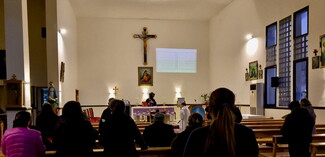
Alma al-Shaab’s residents come together for prayer on March 6, 2026. Alma al-Shaab, South Lebanon. (Photo courtesy of Rana Farah)
We were filled with fear that first night, on Wednesday. Thursday night was a little easier. We were all already so tired because nobody had slept the night before, so everyone slept early last night. Everyone finally slept. The exhaustion is more than just psychological and physical. You’re worried and anxious and have no idea what to do. And there’s absolutely no reassuring news. The only ones who try to reassure us are the UN; the unit nearest to us coordinates with the mayor and Father Maroun [Ghafari], a priest at the St. Mary parish. We didn’t really see UNIFIL on the ground except one time, when they brought things, snacks and such.
Every night is the same story. Every night we anticipate an Israeli invasion. We all gather in the church hall at 6 p.m., every day, and lock ourselves in until the morning.
Why did you decide to stay in Alma al-Shaab instead of leaving when the Israeli army was threatening the town?
Back in 2025, we did leave, and we returned only to find the Israelis had invaded and left our homes in ruin. We’ve spent the last year and two months rebuilding our homes and paying so much money to do so, all so we’re made to leave again? People say they would rather die here than leave their homes again. And anyway, where would we go? Some people have nowhere to go and can’t afford to rent a place. And we’re seeing what’s happening in Beirut… Maybe it’s safer here.
I’m here at the church with my parents and sister. The number of people gathering here is growing. Some people are even leaving Beirut and returning to Alma al-Shaab. There are families and children with us. The youngest of us is five years old and the eldest is 94.
There is a lot of anger at what is happening and who caused it. There is a lot of anger about why we have to keep doing this. My mother was seven years old the first time she was ever displaced, and now we’re displaced again. We have to leave every few years again. Every time, we have to live under gunfire and airstrikes. Today, there’s fear and concern: Are we going to be able to keep securing the things we need? Yes, we have some essential stockpiles, but how long is it going to last us?
The difference between the war and that of 2023 is that in 2023, most people left. There were only 80 people in the village, even before the war was in full swing. This time is different. We’re about 170. People who are ill or who have children have left. The difference is also our new mayor, who left Beirut and returned to stay here with the people. Our priest, too. They’re really standing by people, encouraging us to stay.
When we all made the same choice to stay, it reassured us — khalas, if we die, we die together.
That’s why we’re staying and sleeping in the church hall. It’s been hard. We don’t know if we’ll live to see the next dawn.
After a week of sheltering in place, news began to circulate that the community in Alma al-Shaab was going to be forced out of the town, escorted out by a UNIFIL unit, its soldiers walking ahead of and behind them to ensure their safety. We messaged to check in on Rana on March 6. When she didn’t respond, we reached out again. Finally, on Monday, March 9, Rana responded by saying that she and her family were okay and would likely evacuate the next day.
The mayor received a call from the Lebanese army that the ceasefire monitoring mechanism was asking the people of Alma al-Shaab to leave as soon as possible. There were a lot of arguments that night. Ten people wanted to stay, and they were arguing with the mayor that everyone must stay. Others wanted to leave. The mayor made it clear that the choice is theirs, but that staying was each person’s individual responsibility, considering the nearest hospital is 40 minutes away and the road there is far too dangerous. But when morning came, everybody was ready to leave. The 10 who had wanted to stay had a change of heart and left with everybody else.
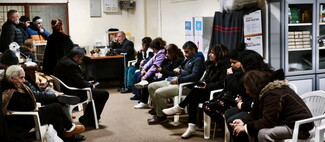
Father Maroun Ghafari on the phone in the hall of the St. Mary Church in Alma al-Shaab, where the town residents have been sheltering since Wednesday, March 4. March 9, 2026. Alma al-Shaab, South Lebanon. (Photo courtesy of Rana Farah)
Rana and her family were safely evacuated from Alma al-Shaab on Tuesday, March 10, and were displaced from their homes yet again. They are currently in Beirut. We spoke to her on Wednesday, March 11.
We’re broken. This is the third time we leave our village. This time, we’re not sure if we will ever return. We felt abandoned — the Lebanese army left us alone last Tuesday. Yesterday was the only other time we ever encountered UNIFIL, which is when they were escorting us out of the town. No one else was present, not even the army. No one but UNIFIL. We were protecting ourselves.
When Sami Ghafari* was killed by an Israeli drone, we asked UNIFIL and the Lebanese army to come and escort us to his burial, but they refused.
*Sami Ghafari, a 70-year-old resident, was killed by Israel in a strike on Sunday, March 8, while tending to his garden in Alma al-Shaab. He is the brother of Father Maroun Ghafari, who was mentioned earlier in this testimony as having gathered the residents of Alma al-Shaab in the church hall for safety.
Share this page