Families of four Lebanese men who disappeared after returning to southern Lebanon gathered outside Beirut’s Grand Serail on Wednesday, June 24, carrying large photographs of their missing relatives and demanding immediate action from the Lebanese government.
Jawad Shadi Bazzi, Hadi Kamal al-Raqqa, Mohammad Ali Hassan, and Ali Musa Qashmar vanished 10 days earlier, after riding motorcycles to the South to check on their villages following a mutual cessation of attacks was accepted by Hezbollah and Israel.
Their relatives told The Public Source they have been relentlessly petitioning Lebanese military intelligence, UNIFIL, and international humanitarian organizations, including the International Committee for the Red Cross, but have yet to receive any information about their whereabouts.
“I just want to know if he’s alive,” Jawad Bazzi’s father said. “He’s my only child. He’s all I’ve got.”
Bazzi, a 19-year-old human rights student at the Islamic University of Lebanon with aspiration to become a lawyer, traveled south with a group of friends. He and Hadi al-Raqqa, also 19, rode on one motorcycle while the rest of the group traveled on six other bikes. At some point, Bazzi and al-Raqqa separated from their friends. According to Bazzi’s father, they were the only two who never returned.
His mother last spoke with him around 4 p.m. About 90 minutes later, Bazzi called a friend to say they had gotten slightly lost but were on their way back to Beirut. No one has heard from them since.
“You know the people of the South,” Hadi al-Raqqa’s uncle, Salah al-Raqqa, said, “the moment they hear that there’s a ceasefire, they immediately head to their villages. They were just being boys. They wanted to get there first and take photos to show everyone they had made it.”

Friends of Jawad Bazzi and Hadi al-Raqqa, some of whom went with them to the South that day, demonstrate in front of Beirut’s Grand Serail. They hold up posters of their friends that read: “Call for Freedom.” Riad al-Solh Square, Downtown Beirut. June 24, 2026. (Lylla Younes/The Public Source)
Mohammad Hassan’s sister-in-law, Naamat Srour, said Hassan, originally from Aitaroun, traveled separately with a friend to the village of Beit Yahoun, north of Bint Jbeil. Like many others returning to the area, he sent photos and videos to his wife upon arriving. Srour believes he may have taken a wrong turn, ending up in the clutches of Israeli occupation forces.
“We're demanding that the Lebanese government understand that these people are not numbers,” she said, struggling to hold back tears. “They have families. They have children and people who love them. We demand that the government think of their families.”
Hassan, 34, is the father of a young son and daughter.
According to the Lebanese Association of Prisoners, at least 37 Lebanese nationals are being held by Israel. Some were abducted during Israel's 2024 war on Lebanon, while others were taken during the 15-month unilateral ceasefire that followed. During that period, Israel violated the agreement more than 15,000 times.
Ahmed Taleb, head of the Lebanese Association of Prisoners, previously told The Public Source that the Lebanese government has done little to advance the cases of those held by Israel. He argued that Lebanon's leadership should use international diplomatic channels to file formal complaints with the UN Security Council and increase pressure for their release.
The frustration was palpable outside the Grand Serail. After about 45 minutes of protest, tensions briefly escalated.
“What are you doing standing there?” Hadi al-Raqqa's elderly aunt shouted. “Move! Into the streets!”
Some demonstrators stepped into the road, blocking traffic, while others remained on the sidewalk. Members of the Internal Security Forces urged them to clear the street and allow vehicles to pass through.

Mohammed Ali Hassan’s sister-in-law, Naamat Srour, holds up his photo at a protest demanding action from the Lebanese government. Riad al-Solh Square, Downtown Beirut. June 24, 2026. (Lylla Younes/The Public Source)
Mohammad Hassan’s 9-year-old daughter burst into tears, pleading with one officer: “May God be pleased with you, don’t make us move. This is my father, not a game. My father! A human being! Do something!”
Security forces eventually allowed demonstrators to block one side of the road while traffic continued on the other.
Two days later, on Friday, June 26, Lebanon, Israel, and the U.S. signed a framework agreement in Washington calling for “confidence-building measures that reflect positive intent.” Only Clause 13 of the trilateral framework mentions the abductees:
“In line with their shared goals to establish stable and peaceful relations, Israel and Lebanon commit to take good faith measures that demonstrate positive intent, including the cessation of all hostile or adverse actions in international political or legal fora, and pledge to work towards the search for and return of remains and the release of detainees.”
The National Human Rights Commission, including the Committee for the Prevention of Torture, rejected “any trade-off between living detainees and the remains of soldiers,” deeming the approach “incompatible with the fundamental principles of international humanitarian law.”
Call for Freedom, a campaign advocating for the release of Lebanese abductees held in Zionist prisons, condemned the agreement, calling it an “agreement of shame and subservience” that “mortgages the fate of Lebanese prisoners and abductees to the occupation.”
“Through this agreement — and specifically Article 13 — the Lebanese authorities ... have granted the Israeli occupation an open-ended license to stall and blackmail, effectively offering the freedom of our prisoners and abductees as a political gift to the criminal Benjamin Netanyahu,” the group wrote. “Our pledge and promise is that we will not abandon our prisoners… We will not forget. We will not give up. We will not be silent.”
Critics have compared the deal to the Oslo Accords, citing provisions for security coordination between the Lebanese army and Israeli forces.
Throughout the weekend, protesters burned tires on Beirut’s airport road, blocking traffic in protest of the agreement.
As of publication, Jawad Bazzi, Hadi al-Raqqa, Mohammad Hassan, and Ali Qashmar remain missing. Their families say they do not even know if they are alive.
As the U.S.-Iran MoU facilitates the return of some residents to their towns and villages, southerners are witnessing their neighborhoods in ruins for the first time.
Families returning home after months of displacement are finding their homes reduced to rubble and entire streets unrecognizable.
Across southern Lebanon, Israel destroyed 11,095 buildings, damaged 17,891 housing units, according to a UNDP assessment. Essential civilian infrastructure has also been severely impacted, with extensive damage to power grids, water stations, telephone lines, and sewage networks, leaving entire communities without access to basic services.
Lebanon’s Ministry of Health announced yesterday that the death toll from Israeli attacks since March 2 has risen to 4,211 with 12,173 others injured.
Photojournalist Marwan Bou Haidar documents the scale of destruction in Srifa, Bir el-Salasel, and Tebnine.

Tebnine, Bint Jbeil, South Lebanon. June 24, 2026. (Marwan Bou Haidar/The Public Source)


Srifa, Sour, South Lebanon. June 24, 2026. (Marwan Bou Haidar/The Public Source)


Srifa, Sour, South Lebanon. June 24, 2026. (Marwan Bou Haidar/The Public Source)

Srifa, Sour, South Lebanon. June 24, 2026. (Marwan Bou Haidar/The Public Source)
On June 3, the U.S. State Department released a joint statement by the U.S., Lebanon, and Israel outlining a framework for ending hostilities between Israel and Lebanon. The statement emerged after a series of direct talks between Lebanese and Israeli representatives, and is the third such agreement since the outbreak of war between the two countries in October 2023.
The framework centers on a series of commitments by Lebanon, including a “complete cessation of Hizbollah fire and the evacuation of all Hizbollah operatives from the South Litani Sector” and the “creation of pilot zones in which the Lebanese Armed Forces will take exclusive control of the territory to the exclusion of all non-state actors.” It does not outline, however, conditions on the Israeli side or set a timetable for the withdrawal of Israeli occupation forces from Lebanese territory.
In a statement released later that day, Hezbollah Secretary General Sheikh Naim Qassem rejected the proposal, describing it as capitulation, and likening it to “Satan’s dream of entering Paradise.” Instead, he urged a united national front in the face of Israel’s continued aggression, calling on the government to “put an end to this farce … be stronger by rallying all your people around the choice of a sovereign state.”
Qassem called for a comprehensive ceasefire and the withdrawal of Israeli forces from Lebanon, vowing that Hezbollah will continue its fight to drive the occupation from Lebanese soil.
The Public Source spoke with Dr. Amal Saad, lecturer in politics at the University of Cardiff and a leading scholar on Hezbollah, about the agreement’s broad political implications. The interview was edited for length and clarity.

Protestors gather in support of Hezbollah at Riad al-Solh Square. One participant holds a sign that reads, “Israel is the reason for this country's hardship, not the resistance.” Downtown Beirut, Lebanon. April 9, 2026. (Marwan Bou Haidar/The Public Source)
How can we understand the joint statement produced after the fourth trilateral meeting between the U.S., Lebanon and Israel? What do you see as the most concerning terms of the agreement to cease hostilities?
What is most astonishing about the document is its redefinition of the conflict itself.
The ceasefire it announces is made conditional not on Israel ending its aggression, withdrawing from occupied Lebanese territory, releasing prisoners, enabling the return of the displaced, or reconstruction in the South, but on “a complete cessation of Hizbollah fire” and the evacuation of resistance fighters from the South Litani sector.
Israel, by contrast, is assigned no reciprocal obligation whatsoever. There is no timeline for withdrawal, no condition requiring an end to Israeli strikes, and no accountability for the war crimes that preceded these talks. What is presented as a mutual cessation of hostilities is therefore a unilateral ultimatum framed as an agreement, one that grants Israel full freedom of movement to continue its aggression, and reserves its right to resume military operations whenever it determines that its conditions have not been met.
The center of gravity is, instead, Hezbollah, which is cast, not as a Lebanese resistance force confronting occupation, genocide, forced displacement, and aggression, but as Lebanon’s primary enemy. Although the claim that “Hezbollah is an enemy of Lebanon” is attributed to Marco Rubio, the decisive fact is that the Lebanese government signed a document containing those words while simultaneously declaring it has no hostile intent towards Israel.
This is not merely a discursive shift, but a major political turning point, insofar as Israel is relegated from enemy state to putative partner helping Lebanon rid itself of the “enemy within”: Hezbollah, and by extension, the people of the South, the Bekaa, and Dahieh.
By making Hezbollah the enemy, its entire constituency — the Shia community as a whole, around 93 percent of whom support the resistance — is also de-nationalized.
So the talks can not actually be called “negotiations” because Lebanon is not negotiating anything. They are a U.S.-Israeli-managed compliance process, with Hezbollah being the problem to be solved, while Israel is treated, not as a party to the conflict, but as the party entitled to decide whether or not Lebanon has complied, and to keep aggressing whenever it claims it has not.
The proposed “pilot zones” must, therefore, be viewed in this context. They are not mechanisms for restoring sovereignty, but a phased internal pacification program managed through the U.S.-Israeli framework, in which the Lebanese Armed Forces are positioned less as Lebanon’s sovereign military force than as an Israeli enforcement instrument — or in other words, occupation transferred into a Lebanese-administered security regime pre-set by Israel and the U.S.
Equally damning is Lebanon’s decision to join the condemnation of Iran and delinking itself from it, at the very moment when Tehran had made Lebanon a central condition of its own negotiations with Washington. Iran was not treating Lebanon as a peripheral file, but as a regional red line — suspending talks with the U.S. in response to Israel’s continued operations in Lebanon and Gaza, threatening the full closure of the Strait of Hormuz unless those attacks ceased, and warning that any Israeli strike on Beirut would trigger direct retaliation against Israel and risk reopening the war against Iran itself.
By signing onto the U.S.-Israeli framing of Iran as the destabilizing actor, the Lebanese government effectively stripped itself of the only counter-leverage available to it, endorsing the very framework designed to isolate that leverage, criminalize the resistance, and leave Lebanon negotiating alone under Israeli fire.
The document also says “this includes the disarmament of non-state armed groups, and the prevention of their re-emergence.” This is a commitment by the government not merely to disarm Hezbollah, but to ensure that no resistance ever emerges again; in other words, to extinguish the resistance identity. This is similar to the first point in the Gaza plan which calls for “deradicalization” of Gaza. Here, too, the government is pledging to disinherit the entire legacy of resistance.
In short, what the government is doing, as Kassem Ghorayeb has astutely observed, is worse than surrender. Surrender would mean that the Lebanese authority acknowledges defeat, submits to the existing balance of power, and relinquishes its rights accordingly, without necessarily adopting the Israeli narrative that Lebanon is the aggressor and Israel the party aggressed against. But what the Lebanese authority is doing today goes far beyond surrender.
How does this moment compare to the period preceding the May 17 Agreement of 1983? And how does that agreement compare to the June 3 statement?
Obviously, there are similarities, but as egregious as the May 17 Agreement was, the documents we have seen emerge from these talks, including and especially, this last statement of intentions, are arguably far worse for Lebanon.
The May 17 Agreement was signed under conditions that could at least explain its existence on the most surface reading, even if this was not why the Gemayel government agreed to it. Israel had just invaded Lebanon, Beirut was under occupation, and the Lebanese state was negotiating with a gun to its head and an army inside its capital. The asymmetry in power and the agreement’s illegitimacy were so apparent that it collapsed within a year.
The current government enjoys none of these even apparent mitigating circumstances, and yet has gone further in every measurable respect. There is no Israeli army in Beirut and the Lebanese state is far from being militarily defeated. Hezbollah’s military capacity is not only reconstituting, but adapting, with its expanding use of FPVs and other drone and missile tactics already producing major tactical gains against Israeli ground forces, while Iran is negotiating with Washington from a position of regional strength and has made a Lebanese ceasefire a priority within those talks. In other words, Lebanon today possesses diplomatic leverage it has simply chosen not to use. This government therefore cannot claim the alibi of 1983 — that is the alibi of a state negotiating under direct occupation, with no political space, no strategic depth, and no available alternatives.
But beyond the context, the May 17 Agreement itself, while shameful and a surrender document, was less catastrophic than this latest document, whereby Lebanon openly endorses the Israeli narrative, and aligns itself strategically with the U.S. and Israel.
Article 1, paragraph 3 and the Annex of the May 17 Agreement stated that “Israel undertakes to withdraw all its armed forces from Lebanon,” with the Annex specifying that “within 8 to 12 weeks of the entry into force of the present Agreement, all Israeli forces have been withdrawn from Lebanon.” This obligation — however bad-faith in intent, however conditional in practice — was written into the text as a named Israeli commitment. The June 3 statement contains not a single clause, phrase, or word concerning Israeli withdrawal from Lebanese territory. Israel does not undertake, commit, or even acknowledge any withdrawal obligation.
The May 17 Agreement was formally bilateral throughout: both parties undertook obligations, both parties were named as responsible for implementation. The June 3 ceasefire is explicitly asymmetrical from its opening operative sentence — “the ceasefire is contingent on a complete cessation of Hizbollah fire and the evacuation of all Hizbollah operatives from the South Litani Sector” — with no reciprocal condition whatsoever imposed on Israel. The ceasefire is not a mutual suspension of hostilities, but is an ultimatum addressed exclusively to one side.
The May 17 Agreement Annex also says this: “Three months after completion of the withdrawal of all Israeli forces from Lebanon, the Security Arrangements Committee will conduct a full-scale review of the adequacy of the security arrangements delineated in this Annex in order to improve them,” whereas the April and June documents make even a ceasefire contingent on a Hezbollah withdrawal/disarmament, let alone withdrawal, which isn’t mentioned.
You have previously warned that Lebanon could slide into civil strife. What is your assessment today?
I see the prospect of civil strife as present as ever, especially if they try to remove [Commander of the Lebanese army] Rodolphe Haykal, or if he resigns. If that should happen, then the Israeli aggression will be only one level of warfare that will engulf Lebanon, and Hezbollah will also have to fight a “counterinsurgency” launched by the state, which will be fighting alongside Israel.
The other scenario is mass public pressure and protests and civil disobedience that will be overwhelmingly Shia, but will also include other sects to a lesser extent. This movement will seek to topple the government, either preceding or alongside the government’s counter-resistance campaign.
What do you believe is behind Hezbollah’s seeming reluctance to confront the government?
Hezbollah is very constrained by the need for stability, the main reason being the over 1.2 million displaced people, who are majority Shia. They’re Hezbollah’s Achilles heel. If there is going to be a popular protest, the party has left it as a last resort, given the ever-present dangers of sectarian strife — especially between the displaced and host communities, particularly aligned with right-wing groups who have been less welcoming of their presence.
I don’t know if you recall, but in his last speech, Sheikh Naim Qassem did threaten public grassroots mobilizations to topple the government. But that was regarding al-Qard al-Hassan.
So that kind of weapon is an option, but they’re leaving it as a last resort. They’re still sort of using Berri now as a bridge and are trying to solve it that way. That’s also why they haven’t left the government, which would be easier, if you think about it; it would be less messy than public protests. The Shia ministers have still not quit the cabinet, and that’s because of the chaos that they fear would come with that — because it would be chaos in the midst of Israeli aggression, which is the most explosive type of scenario that could happen. Otherwise, they know this government is shameless enough to replace any resigned Shia ministers with token ministers who will be aligned with the U.S. and Israel, and will not reflect the community’s political identity. But I would not rule out popular protests in the coming weeks, especially if the government is suicidal enough to try and enforce anything that’s on this agreement.
That also presupposes that there is no agreement between Iran and the U.S., which could still short-circuit everything else. But if that doesn’t happen, and if it drags on much longer, and if the government is emboldened by the very slow pace of the Iran-U.S. talks or the deadlock and actually tries to enact any of the items on the document we saw yesterday, then Hezbollah could potentially use that.
What I am more certain about is the popular aspect — that there very well would be popular protests to bring down the government. I think that could happen, but that would really be a last resort.
How do you imagine the negotiations would have unfolded had they been tied to the U.S.-Iran talks?
This is a good question. If the talks were indirect and under the aegis of the Iran talks, had the Lebanese government done this, the outcome could have been far less asymmetrical, and Lebanon would have been equipped with real leverage. Lebanon would not have entered the talks as an isolated, weak state negotiating under Israeli fire, but as one front within a wider regional equation in which Iran was already treating a Lebanese ceasefire as a condition of any broader settlement.
The U.S. would no longer have been free to dictate terms to a Lebanese government eager to comply; it would have needed to deliver those terms to Lebanon as part of what it owed Iran for cooperation on the nuclear file.
Israel, which could not block a deal embedded in a larger framework that Washington actively needs, would have faced a qualitatively different pressure than it faces when it is simply co-authoring the terms of a Lebanese submission. The question would have ceased to be what Lebanon could be persuaded to accept and instead would have been what Israel is forced to concede; so instead of accepting a ceasefire conditional on Hezbollah’s withdrawal while leaving Israeli occupation and giving Israel freedom of movement, Lebanon could have insisted on a comprehensive cessation of hostilities, and guarantees against renewed strikes as part of the regional bargain.
This would also have made Israeli withdrawal the central focus of the agreement. Given Hezbollah’s ability to inflict heavy losses on Israeli ground troops and forces across the border, particularly through its expanding use of FPV drones and other tactics, Israel would have been forced to withdraw as a precondition for an end to Hezbollah fire and the restoration of security in the north. Under the current talks, by contrast, the government rewards Israel with an illusory promise to prevent the resistance from repelling the occupation, which in practice means bogging Hezbollah down in a civil war, while leaving Israel free to consolidate its annexation of South Lebanon.
None of this is to say that Israel would have easily withdrawn or that the war would have quickly ended, but it certainly wouldn’t have prevented the possibility of either aim being achieved as the current talks are doing now.
Editor’s Note: The article “The Enemy Made My Home His Headline, and I Watched Him Roam Every Corner” was first published in Arabic by Manateq on April 20, 2026.
It was another evening of displacement. We had been forced out of our home and into a room that was witness to our counting down the days, waiting for the return. I was sitting with my family watching the news on television as we usually did, and this was when we saw it: our very own neighborhood appeared on screen. The houses of the neighborhood, and among them our home, flashed before our very eyes. The aired clip was titled “Soldier’s bodycam reveals military devices in a civilian home in southern Lebanon.” And just like that, my home became a fleeting military news story. Earlier that day, a force from the Nahal Brigade had fallen into an ambush on the outskirts of Beit Lif, forcing it to withdraw.
Soon after, on April 17, 2026, we obtained an aerial photograph of the village, showing widespread destruction. Entire neighborhoods had been decimated. Our neighborhood — and in it, our home — was rigged with explosives and blown up, setting the olive and fig orchards on fire.
We knew that the enemy’s advance onto the outskirts of the town would inevitably mean entering homes and orchards and destroying them. Little did we know that they wouldn’t simply enter the house, but also film it from the inside and use it as a stage to fabricate a story, before booby-trapping it then blowing it up.
Last week, the occupation army broadcast images of its soldiers in the neighborhood, seemingly before its destruction. In the footage, they claim to have confronted resistance fighters and to have found weapons inside civilian homes. It wasn’t enough for the enemy to enter and defile the place. They rewrote the entirety of its history and the memories it holds, to suit their twisted narrative. As for the world watching, it can be divided into three: those who are deeply disturbed by the scene, those who believe the narrative on display, and those who watch and stay silent.
How I Imagined the Break-in
The lump in our throats is not from the loss of material things. It is because I woke up to find the enemy walking inside the house I dreamt of returning to every night, transforming it into a battlefield. The doors of those rooms — that we would knock on before entering and through which we would politely seek permission from one another — had been forced open, their locks broken.

Screenshot from a video showing an Israeli occupation soldier rummaging through Riyasa Ismail's family wardrobe. Beit Lif, South Lebanon. April 15, 2026.
I see him scouring the entire house. He finds an old suitcase that we had planned to get rid of, then fills it with old phones, an iPad, a laptop, some cables and connectors, an old passport. He enters our bedroom, opens the closet, finds my sister’s Civil Defense suit and her Risala Islamic Scouts uniform, tears open drawers, takes our diplomas and private records.
He lifts the mattresses, throws our clothes and belongings to the floor. He enters my brother’s room, rummages through the wardrobe, takes out whatever he can adapt for his narrative: a hunting outfit, a cartridge pouch, two hunting rifles. He then goes to my parents’ room, flips the mattress and uses it to cover the window. Then he stages the suitcase with what he has collected inside, arranges the uniforms and hunting weapons beside it, and crafts a scenography of his own design to serve his narrative and fabricated story.
This image became part of a news report, along with multiple houses in our neighborhood, where he staged fictional battles and claimed to have found weapons in the homes of ordinary people. Then he exited the neighborhood, detonated some of the houses, and bombed others. For him, this was the end of the scene.
For us, this was the beginning. First, the shock, then denial in search of some kind of error, followed by acceptance and grief, before realizing that this will only intensify our desire to return. We agreed that, if worse comes to worst, we would pitch a tent under the remaining olive tree and sleep inside.
My House Is Your House and I Have No One To Turn To
Since October 7, I have learned to leave my house in waves. I left the house for 10 months during the “War of Support”, and then for two months during “The Battle of the Fierce” (Awwali al-Ba’s). When that phase was over, the enemy warned us against returning home hardly two months into the ceasefire. Then I left the house again at dawn on March 2, 2026, when the resistance announced it entered the war.
Despite the burden of displacement, leaving the village, and leaving work, knowing that the house was still standing gave me the strength to await our return. To anyone else, my house is like every other house. But for me, these houses are not all the same. Every house has its story, scent, and sound, its symbolism, belongings, and neighbors.

Aerial image of the Darb al-Qawzah neighborhood in Beit Lif as seen in a satellite image after Israeli occupation forces rigged houses with explosives and detonated them. Beit Lif, South Lebanon. April 16, 2026. (Image Credit: Riyasa Ismail)
It is not a pile of rubble as the enemy sees it, and as those who stand “above the fray” see it. The house is us: years of labor, and different stages of our lives gathered in its corners. The house is my mother’s coffee on the balcony among roses and basil. “Bayti ana baytak, ma ilna hada” — “my house is your house, and we have no one else” — I often sang these words and prayed that this blessing would last.
I turn to the French philosopher Gaston Bachelard, who wrote: “the house is our corner of the world.” I quote him to describe the scene from within, not how it appears from outside, and to explain its psychological impact on us, a family that owns this house and what surrounds it. What everyone sees as just a house being violated and bombed — mere walls, tiles, material things — is, in truth, the violation of my selfhood and the sanctity of my home. This violation trespasses onto my personal space and belongings and pries them from my hands.
The enemy sets foot on a land he knows nothing of. He does not know that the hakoura — the little garden outside the house that he crossed — is where my mother would watch our steps closely, ensuring we did not trample the seedlings of mint, thyme, marjoram, onion, and arugula.
Negotiating With the Enemy in Our Homes
It dawned on me that displacement burdens the displaced with a familiar weight, until the house is lost. Then it becomes a beast perched on our shoulders, turning our chests into its grazing ground. Every step toward the village becomes hard, and every step away from it even harder.

Part of Riyasa Ismail’s house, including the courtyard and surrounding oleander, sumac, and pomegranate trees. Beit Lif, South Lebanon. May 16, 2025. (Image Credit: Riyasa Ismail)

The back road to Riyasa Ismail’s house, with part of an olive grove visible along the way. Beit Lif, South Lebanon. May 9, 2025. (Image Credit: Riyasa Ismail)
As we southerners endure the loss of lives, homes, and livelihoods, and as the enemy proudly documents his massacres and violations, the Lebanese state continues down the path of negotiating with him. What is the meaning of negotiations when our villages are being destroyed and as bombs are raining down on us? What is the meaning of peace when our remains are still missing? How will we negotiate with the one who continues to booby-trap our homes to detonate them? How can security be discussed at the negotiating table, when it is stolen from our bedrooms? What ceasefire when the enemy occupies our border villages?
All that’s Left is This Small Bag
We always used to say, “We will return for the things that don’t fit in the bag.” Until we lost those things. Our houses have been destroyed, along with the trees we raised from branches: carob, silver poplar, oleander, mulberry, almond, fig, and olive.
Their systematic entry into the place and its destruction is an attempt to reshape our collective memory — the images of these places in our minds — and to rearrange the pieces to fit their own vision and ambitions.
They would have us abandon any hope of return and fall for the idea that nothing remains for us in our distant villages. Even though it is difficult to restore our memory the way we rehabilitate and rebuild our houses — and even though it is hard to forget that they entered our homes and staged their narrative from within — it is still possible.
Restoring our memory will simply require more time and deep faith that these roots cannot be torn out, that our will cannot be snatched from us. Suitcases may change, but the idea never will.
“When the bombing ended, even excavators couldn’t get in — they kept getting tangled in the wires,” said an eyewitness in Hay el-Sellom, a densely packed neighborhood where buildings are pressed tightly together and electrical wires crisscross overhead.
Located in Beirut’s southern suburbs, Hay el-Sellom had been considered relatively safe throughout the U.S.-Israeli war on Lebanon. It was not included in displacement orders issued by the Israeli military, so markets remained open and people continued moving throughout the area during the day.
The eyewitness, who runs a shop in the neighborhood, described the blast as deafening, with smoke quickly engulfing the streets. He put his 2-year-old child on a motorcycle and took him to safety before returning to help. What he found was widespread devastation: “rubble on top of rubble.” Several sites were struck at once: three buildings near the al-Ghadir River, one near the Arab Mosque, and another near Arweh Junction.
The strikes came hours after the United States and Iran agreed to a temporary ceasefire and the launch of negotiations in Islamabad on April 10. The 10-point plan presented by the Islamic Republic included a ceasefire in Lebanon as a precondition for negotiating with the U.S., raising cautious hope through much of the country.
That hope was shattered the next day, when the Israeli military launched a sweeping bombing campaign across the country, striking more than 100 locations in about 10 minutes, according to the Israeli military’s Arabic-language spokesperson, including densely populated areas of Beirut.

Rescue workers carry out rescue operations at the site of an Israeli strike in Hay el-Sellom, Dahieh. April 10, 2026. (Marwan Bou Haidar/The Public Source)
Israeli Prime Minister Benjamin Netanyahu later praised the speed and scale of the assault, which he called “Operation Eternal Darkness” and was widely reported as Lebanon’s “Black Wednesday.”
The Health Ministry initially reported 87 killed; by Friday, the toll rose to 357 as rescue teams and volunteers worked around the clock to recover bodies. At least 1,200 people were injured.
In Beirut, strikes targeted Ain al-Mreisseh, Basta, Corniche al-Mazraa, Bashoura, Borj Abi Haidar, and Dahieh’s Chiyah neighborhood. In Ain al-Mreisseh, an airstrike leveled a building, killing 27 residents. A strike on a funeral procession in Shmustar in the Bekaa Valley killed 10 people. Three girls were martyred in Adloun in the South. A family of four was killed in the northeastern village of Mansoura, and four others were killed in a strike on the southeastern town of Majadel.
Videos spread quickly across news channels: cars crumpled into unrecognizable shapes, thick black smoke rising in columns, and white-gray dust coating every surface.
Not since the Zionist entity’s pager attack in September 2024 have medical workers in Lebanon seen such a sudden influx of people injured.
Across the country, doctors, nurses, and paramedics — on and off duty — scrambled to respond. Dr. Ghassan Abu Sittah, chair of conflict medicine at the American University of Beirut, told Arab News that Israeli operations like Wednesday’s are designed to inflict mass casualties in a short time to overwhelm the healthcare system.
“Buildings are being targeted to collapse on their inhabitants,” he said. “Many victims die from suffocation under the rubble.”

First responders at the site of an Israeli airstrike in Tallet el-Khayyat, Beirut. April 9, 2026. (Marwan Bou Haidar/The Public Source)
Yahya Obeid, an anesthesiologist at Makassed General Hospital in Beirut’s Mazra’a neighborhood, spoke to The Public Source by phone between surgeries on April 8.
“The situation is grim. The emergency room is jammed,” he said. “It’s chaos down there. There are too many patients to count.”
While many injuries were minor and could be treated in the ER, he added, a steady stream of critical cases requires surgery and intensive care. In Obeid’s operating room, staff moved patients from one procedure to the next.
“Vascular injuries, tendon damage, amputations, internal trauma — spleens, limbs, eyes, faces, brains,” he said, listing the cases they were handling.
At least seven children were treated in the pediatric ward. One child survived surgery, but another, a 13-year-old, was in a vegetative state.
Despite the strain, the hospital continued to function, largely due to off-duty staff who returned to assist. “Many staff are volunteering. It’s a full house: doctors across specialties, nurses, cleaners, and drivers,” he said.
Healthcare workers with years of experience treating victims of one calamity after another were devastated by the conditions of those arriving at the hospital.
“We’ve seen so much [over the course of our careers] — severed limbs, organs torn apart. And still, some of my coworkers are breaking down crying,” he said. “It’s the shock of it, the scale of it... Tthe amount of grief, the injuries, the deaths. It’s overwhelming.”
Some of Lebanon’s hospitals may run out of life-saving trauma kits within days as supplies rapidly dwindle after mass casualties from the latest wave of Israeli strikes, the World Health Organization’s representative in Lebanon told Reuters on April 9. These kits, containing essentials such as bandages, antibiotics, and anesthetics, are critical for treating war-related injuries.

A family passes by a scene of destruction in Tallet el-Khayyat, Beirut. April 9, 2026. (Marwan Bou Haidar/The Public Source)
Anis Germani, a physician and health policy consultant, told The Public Source that Beirut’s major hospitals are already at capacity. Some smaller private hospitals have stopped admitting new patients, he said, because government reimbursements from the Health Ministry do not cover the full cost of care, prompting profit-driven facilities to restrict admissions.
Larger hospitals remain open but are already strained by years of political and economic crises.
In southern Lebanon, Germani said six hospitals have been put out of service by the war, though some have partially resumed operations, particularly in emergency departments.
“Based on the 2024 war, hospitals in southern Lebanon proved more resilient than others,” he said. But the latest assault has stretched response capacity to its limits. While the country does not lack paramedics, he added, the intensity and geographic spread of the attacks have left them spread thin.
And then there are the bodies still trapped beneath the rubble.
As of Monday, the Disaster Risk Management Unit reported eight people still missing in Beirut, including one child, and that 21 victims were recently identified by families or hospitals.
Saad Ahmar, head of the South Metn coastal region at the Lebanese Civil Defense, told The Public Source that most of the bodies they recovered were women and children, including one building where six children under age 10 were pulled from the rubble.
Rescue operations remain dangerous, as Israel has repeatedly targeted first responders in “double-tap” strikes, where a second strike hits the same site after emergency teams arrive. Ahmar said crews are aware of the risk and often wait before entering strike sites, but safety is not guaranteed.
Since March 2, Israel has killed at least 88 medics, according to Lebanon's Health Ministry.
“What gives you the motivation to push is saving just one life — you feel you’ve achieved something,” Ahmar said. “All our volunteers and staff run to the site of the strike without fear, because their only goal is to help people and minimize damage.”


The search and rescue team ended its operations yesterday, with a total of 81 people found dead in Hay el-Sellom, according to Al Mayadeen.
The intensity of Israel’s bombardment on April 8 overwhelmed hospital morgues. Nearly a week later, they are still holding unidentified bodies and fragments of remains. In Beirut, Rafik Hariri University Hospital — the country’s largest public hospital — received most of the dead and wounded. Its director, Dr. Mohammad al-Zaatari, told The Public Source that several bodies in the morgue remain unidentified.
According to a security source at the Ministry of Interior, forensic laboratories have received 19 samples from hospitals across Beirut and the South. Preliminary testing has matched the samples to 12 individuals. The ministry has also received samples from four families seeking identification, though none of the cases has been definitively confirmed. The identification process takes 48 to 72 hours.
“It’s expensive, but it’s manageable,” the ministry source said. “It’s part of what we do, as during the explosion at the Beirut Port and the last war.”
Families with no word on missing relatives arrive at Rafik Hariri University Hospital searching for answers. If their loved one is not among the injured patients, they are taken to the morgue, Zaatari explained, where they search through burned, disfigured, or dismembered remains for recognizable features.
“It makes you want to cry, or hit your head against the wall, or just scream in anger because the scene is so difficult,” Ahmar, from the Civil Defense, said referring to targeted sites. “The scenes are extremely harsh — a crime in every sense of the word.”
Israel launched a series of strikes across Lebanon on Wednesday afternoon, targeting residential neighborhoods in Beirut, its outskirts and suburbs, south Lebanon, Baalbek and the Bekaa-Hermel region.
Israeli occupation forces carried out more than 100 strikes across the country in about 10 minutes, the Israeli military’s Arabic-language spokesman said in a post on X, describing it as its largest attack since March 2, 2026. The UNHCR office in Lebanon said more than 60 areas were hit.
Israeli airstrikes targeting densely populated residential areas, including apartment complexes and grocery shops, killed at least 254 people and wounded 1,165, according to Lebanon’s Health Ministry. Ghassan Abu Sitta, chair of conflict medicine at the American University of Beirut wrote in a post on X that Beirut hospitals were “flooded with the wounded.” In an interview with Al Jazeera, Health Minister Rakan Nassereddine called for international aid for the country’s medical sector.

Israel targets Burj Abi Haidar, Beirut. April 8, 2026. (Marwan Bou Haidar/The Public Source)

First responders at the site of the Israeli airstrike on Burj Abi Haidar, Beirut. April 8, 2026. (Marwan Bou Haidar/The Public Source)
In the village of Shmestar, an Israeli airstrike struck a funeral procession, killing at least 10 people, including three first responders, and wounding 15 others.
In Saida, an airstrike killed Sheikh Sadek al-Naboulsi, a political science professor and popular religious figure close to Hezbollah, after hitting the al-Sayyida al-Zahraa complex. His brother, Mohammad Afif al-Naboulsi, who headed Hezbollah’s media relations office, was assassinated by Israel on November 17, 2024.
Said el-Khansa, the son of a former mayor of Ghobeiry, was killed in a separate attack that wounded several members of his family.
In Sour, Israeli attacks killed Sawt al-Farah journalist Ghada Dayekh, whose body was later recovered from the rubble. Al Manar journalist Suzanne Khalil was also killed in an Israeli airstrike in Kayfoun.
Israel has killed 28 journalists and media workers since late 2023, 13 of them were directly targeted, according to data compiled by The Public Source.

Saida's al-Sayyida al-Zahraa complex is one of dozens of sites Israel attacked during its fire belt across Lebanon on April 8. The Israeli strike on al-Zahraa Mosque killed Sheikh Sadek al-Naboulsi, brother to martyred Hezbollah media relations head Mohammad Afif al-Naboulsi. Saida, South Lebanon. April 8, 2026. (Marwan Bou Haidar/The Public Source)
Early Wednesday, U.S. President Donald Trump and the Supreme National Security Council of the Islamic Republic of Iran announced their respective acceptance of a two-week ceasefire deal. The agreement is conditional on Iran reopening the Strait of Hormuz, the halting of attacks against Iran, and the U.S. accepting Iran’s 10-point plan as a framework for negotiations, which includes the withdrawal of U.S. forces from regional bases as well as the end of the war on “all components of the Axis of Resistance.”
Iran said it had “achieved a great victory and forced the criminal America to accept its 10-point plan.”
Shortly after the announcement, Hezbollah said it would pause its operations, as Lebanon was included in the agreement, according to Pakistan’s Prime Minister Shehbaz Sharif, who was brokering the temporary peace deal between the U.S. and Iran.
Israeli Prime Minister Benjamin Netanyahu later said, however, that the ceasefire did not apply to Lebanon, and shortly after his country struck Lebanon, Trump told PBS News that Lebanon was “not included in the deal.”
Lebanon’s Ministry of Foreign Affairs welcomed the ceasefire but said that “no entity has the right to negotiate on behalf of Lebanon,” calling such efforts a violation of its “sovereignty.” The ministry added that Lebanon is ready for “direct negotiations with Israel.”
Lebanese Prime Minister Nawaf Salam called for support from “friends of Lebanon” in a post on X to stop Israel’s aggression “by all available means,” saying that Israel is disregarding, and has never respected, principles of international law.
Iran’s Fars news agency reported that the country is preparing to respond to Israel’s strikes, and the Islamic Revolutionary Guard Corps warned Israel and the United States: “If the attacks on our beloved Lebanon do not cease immediately, we will act according to our duty and deliver a resounding response to the evil aggressors in the region.”
Iran halted oil tanker traffic through the Strait of Hormuz as Tasnim news agency later reported that Iran may withdraw from the ceasefire if Israel continues its new campaign, “Operation Eternal Darkness" against Lebanon.


About 90 minutes after the strikes, the Israeli military spokesperson issued a threat to all the residents of the country by making an unsubstantiated claim that Hezbollah has repositioned in other parts of the country. The post on X included a map of Lebanon resembling maps previously used to signal displacement notices.
Israel resumed its attacks in the early evening, striking a residential building in Tallet el-Khayyat. Several nearby buildings collapsed from the impact, and rescue teams are working through the rubble to locate residents. At the time of publication, search and rescue efforts are ongoing as people are reported missing and trapped under rubble.
Lebanese academics, journalists, artists, and activists held a protest on Tuesday in Beirut’s Riad al-Solh Square to call for a comprehensive national resistance to Israel’s continued aggression on Lebanon.
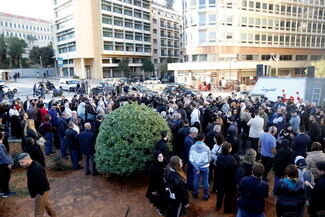
Around 150 people gather in Riad al-Solh Square to call for a comprehensive national resistance against the ongoing Israeli aggression on Lebanon. Riad al-Solh Square, Beirut. March 31, 2026. (Marwan Bou Haidar/The Public Source)
The rally was called for after the organizers started a petition titled “The National Call for Comprehensive Resistance in the Face of the Aggression on Lebanon” on March 16, signed by more than 550 people. Among the signatories is the late journalist Fatima Ftouni, killed in a targeted Israeli attack alongside colleagues Ali Shoeib and Mohammad Ftouni on March 28.
Participants and speakers included recently freed former militant Georges Abdallah, MP Elias Jradi, and rapper Jaafar Touffar. Many university professors also took part, notably co-organizer and AUB professor of chemical engineering Dr. Kassem Ghorayeb, LAU media and journalism professor Dr. Jad Melki, and Middle East history professor Dr. Hicham Safieddine.
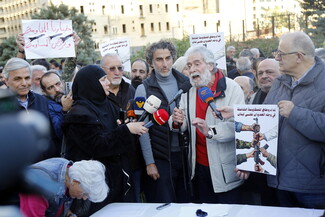
Former militant Georges Abdallah participates in the rally for a comprehensive national resistance and gives a short speech to the crowd. Riad al-Solh Square, Beirut. March 31, 2026. (Marwan Bou Haidar/The Public Source)
Abdallah gave a speech to those gathered, warning that the region is under “imperialist Zionist attack,” and that no country in the region is safe from Israel’s destruction: “What has happened in Syria will happen elsewhere, and awaits us all.”
“Lebanon possesses all the elements of steadfastness; its fedayeen possess a strong will and solid understanding of what is necessary for successful resistance. It is high time our parties rise to this level,” Abdallah said to those gathered at the rally. “Let it be clear to all that the fundamental matter at hand is this: if Iran is defeated today, we will all be swept away by history. We must stand on our feet and look toward the future: a comprehensive defeat for all imperialist powers in our world. It is only after that we create a new world.”
At the end of the petition, in a list of 11 points, the organizers highlight Israel’s intention to sow internal discord by playing on historical sectarian divisions, which, the organizers write, necessitates “subjecting the Lebanese state to Israeli security and political demands, transforming it into a guardian of the Zionist entity and its agent for eliminating the resistance.”
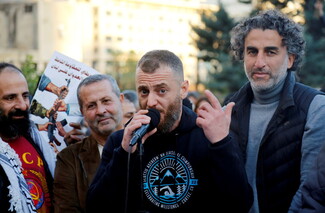
Rapper Jaafar Touffar raps in praise of the resistance, condemning the government’s response to Israel’s aggression and denouncing normalization with Israel. Riad al-Solh Square, Beirut. March 31, 2026. (Marwan Bou Haidar/The Public Source)
The organizers also condemn the government’s approach to Israel’s aggression and its treatment of the resistance, specifically naming the official decision instituting the state monopoly on arms of August of last year, the decision criminalizing Hezbollah’s military activities of March 2, and the state’s failure to defend the residents of the targeted areas which it claims are under its sovereignty.
They point out that this has “legitimized Israeli aggression as a form of counterinsurgency and facilitated the collective punishment of the community supporting the resistance, aiming to force it to abandon the resistance.”
They also condemn the government for willingly dissipating Lebanese sovereignty through its official positions on Israel’s aggression and on the resistance, perversely casting the resistance as an adversary.
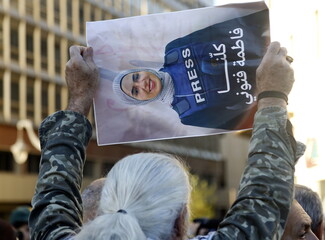
A protestor holds up a poster of late journalist Fatima Ftouni, whom Israel targeted and killed on March 28. The poster reads: “We are all Fatima Ftouni.” Riad al-Solh Square, Beirut. March 31, 2026. (Marwan Bou Haidar/The Public Source)
The organizers argue that true sovereignty is earned through lived experience; through resistance and sacrifice, rather than international recognition or legal formalities: “The resistance’s confrontation of the aggression today is a reaffirmation of the concept of sovereignty as an organic bond between the people and the land, based on historical continuity and collective memory, constantly produced and reproduced through struggle and sacrifice.”
In the statement, the organizers indict the government for its “state of defeatism before the enemy entity, complete subservience to American dictates, and the abdication of sovereign responsibilities,” namely through its hostility toward the resistance, its positioning of the Lebanese army against the resistance, and its direct negotiations with Israel.
The petition lists the following demands:
- “The President of the Republic must adhere to his oath of office and his previous and subsequent positions regarding the issue of the resistance’s weapons, which he considers a sovereign matter not subject to external dictates, and which can be discussed within the framework of a national defense strategy. The President of the Republic must fulfill his responsibility to defend Lebanon.” The President is also called on to act on comments he made during his time leading the Lebanese army, when he emphasized the necessity of liberating the remaining occupied territories, specifically Shebaa Farms and Kfarshouba Hills, the weight of the Israeli threat to Lebanon, and the right to resistance until liberation.
- “Integration between the army and the people who defend their homeland”: “The cohesion and solidarity of the people in the face of external aggression, coordination and integration between the state and the resistance at this stage, and the state's utilization of all its resources to reach a ceasefire agreement, liberate the land, prevent attacks, secure the release of prisoners, and preserve sovereignty.”
- “Embrace and support displaced persons” as it is “a national duty incumbent first and foremost upon the state, and then upon all of society, particularly its political and civil forces, including civil, educational, and religious institutions, in a manner that guarantees the dignity of the displaced and alleviates the material and moral burdens of displacement.”
- “The gravity of the Zionist project against Lebanon in its current phase necessitates that all liberation forces — individuals, elites, and groups — organize themselves within the framework of comprehensive resistance. This resistance must be manifest in all aspects of daily life and occupy the public sphere, especially given the colonial control over traditional media in Lebanon and the region. Political and popular struggle is a necessary, urgent, and pressing duty.”
This comes as Israeli attacks on Lebanon since March 2, have killed more than 1,268 people, wounded more than 3,750 and displaced over one million individuals. Israeli occupation forces have also attempted to push deeper into southern Lebanese territory in recent days, with resistance fighters relentlessly blocking their attempts.
Hundreds gathered at the Rawdat al-Imam al-Sadek temporary cemetery in Choueifat for the funeral of journalists Ali Shoeib, Fatima Ftouni, and her younger brother, cameraman Mohammad Ftouni on the morning of March 29.
Mourners wailed in grief under heavy rain and chanted, “Death to Israel! Death to America!”
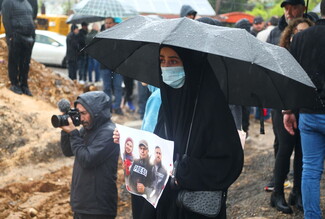
A woman clutches a photo of martyred journalists Ali Shoeib, Fatima Ftouni, and Mohammad Ftouni during the funeral procession for the three. Rawdat al-Imam al-Sadek temporary cemetery, Choueifat, Dahieh. March 29, 2026. (Marwan Bou Haidar/The Public Source)
A day earlier, on March 28, Israel assassinated Al Manar’s Ali Shoeib, one of Lebanon’s most prominent journalists, and Al Mayadeen’s rising star Fatima Ftouni, alongside Ftouni’s younger brother, freelance videographer Mohammad. Israeli airstrikes targeted their vehicle on the Kfarhouna road near Jezzine.
Eyewitnesses said Fatima ran from the vehicle after the first strike, when the car was struck again with two missiles and set ablaze. As she tried to escape, a car carrying two paramedics from the Islamic Health Authority, Ahmad Anisi and Mohammad Daher, stopped to provide assistance. After they exited the car to help her, an Israeli drone then fired two more missiles, killing all three.
Standing near the scorched vehicle, Fatima’s colleague Jamal Ghourabi reported from the site, holding up burned press vests recovered from the car. “This is Israel,” he said.
“The Voice of the South”
Hajj Ali Shoeib, 56, was from al-Sharqiyah near Nabatieh, and was known for his meticulous reporting on Israel’s attempts to reassert its presence in the South after its liberation in May 2000.
He joined Al Manar in 1999 and became the “voice of the South” — a nickname he earned for his dedicated reporting from southern Lebanon. Over the course of his career, Shoeib reported from Lebanon and Iraq, bearing witness to battles against Takfiri groups, including in the Beqaa during the 2017 Arsal battles.
He continued reporting through the October 2023 war and was known for his close coverage of clashes between Hezbollah and the Israeli occupation.
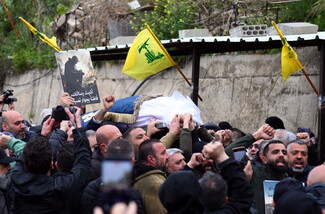
Mourners carry the body of martyred journalist Ali Shoeib, draped in an Al Manar flag, through a crowd during his funeral procession. Rawdat al-Imam al-Sadek temporary cemetery, Choueifat, Dahieh. March 29, 2026. (Marwan Bou Haidar/The Public Source)
Many remember Shoeib from a September 2022 video report in which he confronted Israeli soldiers as they fortified their occupation in the Shebaa Farms.
“Don’t come any closer, back off,” he warned them.
Shoeib later said: “This Israeli soldier standing here doesn’t dare approach me further. I am standing on liberated Lebanese land, while he stands on the occupied Lebanese land of Shebaa Farms.”
Shoeib was among the first to document the collapse of the occupation’s checkpoints at Qantara and al-Qusair. He also documented early Israeli attempts to divert and seize water from the Wazzani River after the withdrawal.
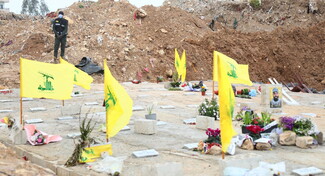
Hezbollah flags line a temporary mass cemetery in Dahieh, where Ali Shoeib, Fatima Ftouni, and Mohammad Ftouni were buried after a targeted Israeli attack on their car the day prior. Rawdat al-Imam al-Sadek temporary cemetery, Choueifat, Dahieh. March 29, 2026. (Marwan Bou Haidar/The Public Source)
Shoeib understood the risks of his work and had acknowledged and accepted that he had become a target.
“Israeli media mention me by name, and soldiers even address me directly, saying ‘Your turn is coming’ but I pay no attention,” he told Al-Akhbar in 2023.
“They see me as a provocation because I expose their violations. I’m not trying to provoke them, I’m just doing my job professionally, without theatrics. I do not yield to Israel. I aim to reveal the truth of the enemy through the reports and images I publish.”
Journalist Hosein Mortada told Mundo America that occupation forces regularly sent Shoeib text messages and emails explicitly threatening to kill him. Israeli drones routinely followed him to intimidate him, but he refused to back down.
“Until Our Very Last Breath”
Fatima, 30, and her brother Mohammad Ftouni, were from Taybeh, a village in Marjeyoun near Lebanon’s southeastern border, now a site of intense close-quarters clashes between the Israeli occupation and the Lebanese resistance.
Fatima joined Al Mayadeen in 2020 and was known for her consistent and courageous reporting from high-risk areas along the Blue Line, even amid ongoing fighting.
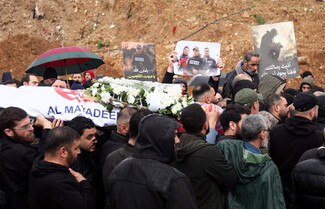
Mourners carry the body of martyred journalist Fatima Ftouni, draped in an Al Mayadeen flag during the funeral procession. Rawdat al-Imam al-Sadek temporary cemetery, Choueifat, Dahieh. March 29, 2026. (Marwan Bou Haidar/The Public Source)
Fatima said that, in the absence of accountability and the ineffectiveness of international law, it was her duty to document Israel’s crimes.
“As long as there’s no response to Israelis, and as long as it is not being held accountable for these crimes, and as long as the international community keeps looking away, it will continue and will go further in its intentional and clear crimes,” she said in a documentary by The Real News Network released in May 2025.
In October 2024, Fatima survived an Israeli strike on a compound housing journalists in Hasbaya. Three journalists were assassinated in the attack as they slept.
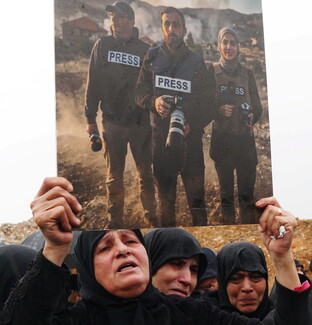
A woman holds up a photo of slain journalists Ali Shoeib, Fatima Ftouni, and Mohammad Ftouni during their funeral procession, held one day after Israel targeted their car on Kfarhouna road near Jezzine. Rawdat al-Imam al-Sadek temporary cemetery, Choueifat, Dahieh. March 29, 2026. (Marwan Bou Haidar/The Public Source)
Hours later, she held up her damaged press vest, helmet, and a melted microphone and said: “This is the weapon that we carry; this is the rocket for which Israeli warplanes raided us.” She continued, “We stand here atop the rubble of our homes and the destruction in Hasbaya, and affirm that we will continue to expose the truth, the reality, and the crimes of the Israeli occupation — until our very last breath.”
Fatima’s father, Abbas Ftouni, told Al Mayadeen he had not seen his two children in 28 days — nearly a month since the latest war on Lebanon began.
“Fate got to them first,” he said.
Ten members of the Ftouni family have been killed since the start of this latest escalation, including Abbas’ brother and his family. Less than a week before Fatima and Mohammad were killed, their grandmother succumbed to injuries sustained in an earlier strike that killed their uncle and his family.
Despite his loss, Fatima's father, Abbas remained steadfast, saying, “This path was paved with blood… By God, we will be victorious… The path must continue, whether we offer martyrs or not.”
On Wednesday, March 18, 2026, at around 1:30 a.m., Israeli occupation forces targeted a building in Zuqaq al-Blat, deliberately killing Al Manar political programs director and veteran anchor Mohammad Sherri and his wife Amal. The two are among 12 people killed in airstrikes that struck multiple parts of Beirut, starting at 1:30 a.m. and continuing into the early morning hours.
Sherri’s children and grandchildren were injured and have since been hospitalized. Among them are his son — also a media worker — Yasser Sherri, and Yasser’s daughter. Yasser works as an editor for the Iraq-based Aletejah channel, affiliated with Kata’ib Hezbollah.
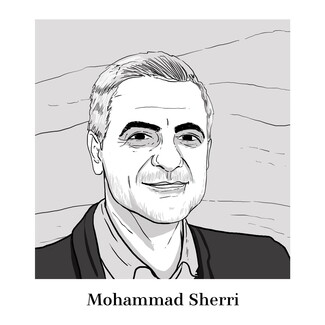
(Illustration by Amy Chiniara/The Public Source)
The airstrike targeted the house Mohammad Sherri was in, as he was recovering from surgery. Eyewitnesses at the scene reported that the walls of two adjacent apartments were blown off completely.
The president of the state-affiliated Press Editors’ Syndicate, Joseph al-Kossaifi, characterized the attack as an “assassination.” The Union of Journalists in Lebanon, the independent union established during the October 17 uprising, condemned the attack in a statement, and called on the state to fulfill its duty to document and investigate Israel’s war crimes in Lebanon.
Sherri’s killing is part of a systemic campaign to target Hezbollah socially and politically as much as militarily — a directive that Israel has intensified since the war began in October 2023. Not only does the Zionist entity go after journalists as an attempt to suppress the documentation of its own crimes, it specifically assassinates media workers who align themselves with Hezbollah and the Lebanese resistance. Targeting these civilians is an attempt to silence the voices that connect the military front with the popular base of the resistance.
Beside leading the television station’s political programming, a role he held for a decade, Sherri also served on the Board of Directors. Throughout his long and dedicated career, “he embodied the image of the militant journalist,” Al Manar said in a statement. Adding that he was a “committed nationalist, who believed in the power of the liberated word to defend what is right, no matter the sacrifice.”
His audiences will remember him as a “cultured, balanced, and logical interviewer,” while his colleagues knew him to be “ethical, calm, and dedicated.”
Al Manar mourned Sherri “as a martyr for free speech” and made a pledge to him and all the fallen martyrs “to keep marching on the path of justice.”
Since October 2023 until today, Israel has killed 22 media workers and journalists across Lebanon in both direct and indirect strikes.
(Illustration by Amy Chiniara/The Public Source)
Just over a month after Israel first targeted a group of journalists in Alma al-Shaab on October 13, 2023 — killing Reuters video journalist Issam Abdallah and seriously injuring Christina Assi of Agence France-Presse — Israeli occupation forces targeted and killed two journalists and one media worker reporting from Tayr Harfa for Al Mayadeen TV.
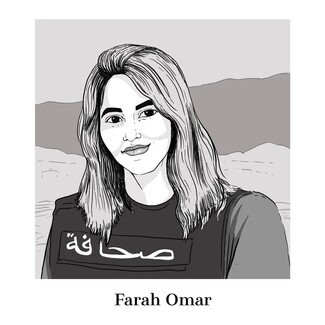
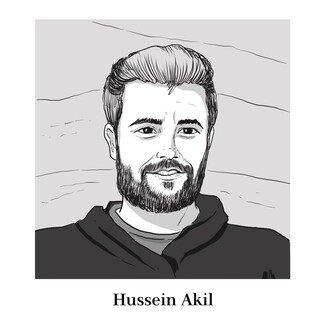
The airstrike on Tayr Harfa on November 21, 2023, killed correspondent Farah Omar, videographer Rabih al-Maamari, and local field producer Hussein Akil. They were 25, 44, and 30 years old, respectively.
Farah Omar hailed from Mashghara, in the Bekaa, and Hussein Akil from Jibbain, in south Lebanon. In Al Mayadeen’s broadcast that night, correspondent Wafa Saraya described Omar as passionate about her work, and said Farah lived up to her name, which means “joy.”
(Illustration by Amy Chiniara/The Public Source)
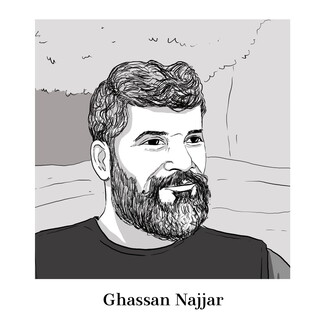
A year later, on October 25, 2024, at 3:30 a.m., the Israeli military targeted 18 journalists as they slept at a compound in the southeastern Lebanese town of Hasbaya, killing Al Manar videographer Wissam Qassem, Al Mayadeen videographer Ghassan Najjar, and Al Mayadeen broadcast engineer Mohammed Reda, and injuring three others.
They had relocated to the compound after the Israeli military issued a forced evacuation order that included Ibl al-Saqi, where they had been reporting earlier. The group believed they would be safe after relocating to Hasbaya.
Journalists reporting from southern Lebanon always inform UNIFIL of their movements and places of rest. UNIFIL, in turn, informs all parties involved, meaning the Israeli military was fully aware that the bungalows in Hasbaya housed reporters and their crews. The information that was supposed to protect these media workers was, instead, used to target and kill some of them.
(Illustration by Amy Chiniara/The Public Source)
In an interview with the Guardian shortly after the attack, Najjar’s wife, Sana, said she cannot believe her husband was killed. “I’m still waiting for the door to open and for him to enter,” she said. “He promised me that we would grow old and go live in the South together — but now he stayed there and I will stay here, in Beirut, forever.”
The Public Source has been documenting attacks on journalists since the start of the war. The following list has been compiled using the most reliable information available at the time of publication. We encourage our readers to contact us with any corrections.
Media Workers Killed Between October 13, 2023 and November 27, 2024
- Issam Abdallah (1986–2023)
- Affiliation: Reuters video journalist
- Date of killing: October 13, 2023
- Location: Alma al-Shaab
- Farah Omar (1998–2023)
- Affiliation: Al Mayadeen correspondent
- Date of killing: November 21, 2023
- Location: Tayr Harfa
- Rabih al-Maamari (1979–2023)
- Affiliation: Al Mayadeen videographer
- Date of killing: November 21, 2023
- Location: Tayr Harfa
- Hussein Akil (1993–2023)
- Affiliation: Local field producer
- Date of killing: November 21, 2023
- Location: Tayr Harfa
- Kamel Karaki (undetermined–2024)
- Affiliation: Al Manar videographer
- Date of killing: September 24, 2024
- Location: Qantara
- Hadi al-Sayyed (2002–2024)
- Affiliation: Al Mayadeen, social media unit
- Date of killing: September 24, 2024
- Location: Burj Rahhal
- Hussein Safa (undetermined–2024)
- Affiliation: Hawana Lebanon photographer
- Date of killing: October 11, 2024
- Location: Mayfadoun
- Mohammed Ghadboun (undetermined–2024)
- Affiliation: Freelance photographer
- Date of killing: October 16, 2024
- Location: Qana
- Mohammed Bitar (undetermined–2024)
- Affiliation: Nabatieh municipality journalist & communications officer
- Date of killing: October 16, 2024
- Location: Nabatieh
- Ali al-Hadi Hassan Yassine (undetermined–2024)
- Affiliation: Al Manar videographer
- Date of killing: October 23, 2024
- Location: Dahieh
- Hassan Roumieh (1995–2024)
- Affiliation: Al-Wadi News Group reporter and & al-Risala Scouts rescue worker
- Date of killing: October 23, 2024
- Location: Maarakeh
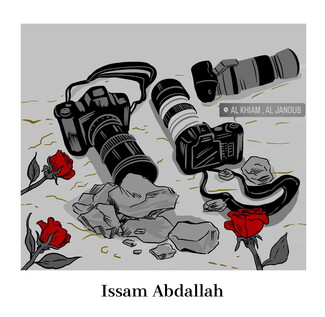
An illustration of the moment journalists put their cameras on martyred journalist Issam Abdallah's grave during his funeral in his home town of Khiam, South Lebanon. October 14, 2023. (Illustration by Amy Chiniara/The Public Source)
- Ghassan Najjar (undetermined–2024)
- Affiliation: Al Mayadeen videographer
- Date of killing: October 25, 2024
- Location: Hasbaya
- Mohammed Reda (undetermined–2024)
- Affiliation: Al Mayadeen broadcast engineer
- Date of killing: October 25, 2024
- Location: Hasbaya
- Wissam Qassem (1986–2024)
- Affiliation: Al Manar videographer
- Date of killing: October 25, 2024
- Location: Hasbaya
- Sukayna Mansour Kawtharani (undetermined–2024)
- Affiliation: Radio al-Nour correspondent
- Date of killing: November 12, 2024
- Location: Joun
Media Workers Killed During the Cessation of Hostilities
- Ali Hassan Ashour (undetermined–2024)
- Affiliation: Radio al-Nour correspondent
- Date of killing: December 3, 2024
- Location: Unknown
- Mohammad Ibrahim el-Souli (2001–2024)
- Affiliation: Hawana Lebanon photographer/videographer
- Date of killing: December 16, 2024
- Location: Unknown
- Ahmad Haitham Farhat (undetermined–2025)
- Affiliation: Nabaa TV executive producer
- Date of killing: February 15, 2025
- Location: Airstrike on his vehicle at the Jarjouh-Arabsalim intersection, Iqlim al-Tuffah
- Mohammad Shehadeh (2001–2025)
- Affiliation: Hawana Lebanon head, journalist, & photographer
- Date of killing: August 8, 2025
- Location: Airstrike on his vehicle on Zahrani road
- Ali Noureddine (undetermined–2026)
- Affiliation: Al Manar anchor
- Date of killing: January 26, 2026
- Location: Israeli airstrike on his vehicle in al-Hosh, Sour
Media Workers Killed After the Escalation of Hostilities on March 2, 2026
- Hussein Hijazi (undetermined–2026)
- Affiliation: Freelance photographer, media activist
- Date of killing: March 6, 2026
- Location: Qabrikha
- Mohammad Sherri (1960–2026)
- Affiliation: Al-Manar TV political programs director
- Date of killing: March 18, 2026
- Location: Zuqaq al-Blat
Several days after Israel’s bombing campaign forced her from her home in the Bir al-Abed neighborhood of Beirut’s southern suburbs, Amal stood in a Hamra vegetable market, carefully selecting eggplants. Her brow was tight with worry.
“The price is now over L.L. 180,000 per kilo,” she said. Just two weeks earlier, she was paying between 120,000 and 130,000. In less than a month, the cost doubled. “We don’t know what to feed our kids anymore. Yesterday, I made a zucchini dish that cost L.L. 1.2 million; it used to cost me 900,000.”
The sharp price increases Amal confronted in the Hamra market reflect a broader national crisis. While official inflation figures have yet to capture the upheaval of recent weeks, the Ministry of Economy and Trade’s weekly price data for Beirut and Mount Lebanon shows sharp rises in essential goods between February 23 and March 9. In that short span, the price of cucumbers more than doubled; mint climbed by 25 percent; bananas by 41 percent; and lamb by 21 percent.
These increases have already exceeded the 15 percent national food inflation rate recorded for the entire previous year. In the absence of comprehensive official data, market conditions suggest a far more volatile reality — one in which a year’s worth of inflation appears to be unfolding in a matter of days.
The government set this surge in motion at the start of Ramadan in mid-February when it raised gasoline prices by L.L. 300,000 per tank — a move that triggered inflationary ripples across every food category. This domestic policy failure was further exacerbated by a global rise in food production costs driven by the U.S.-Israeli war on Iran, and compounded by the systematic disruption of Lebanon’s domestic supply chains as a result of Israeli attacks.
Then, on March 10, the Economy Ministry hiked the price of bread. The small bundle went up by L.L. 5,000 and the large by L.L. 8,000.
Today, at least 1 million people have been displaced in Lebanon and a yet-to-be determined number of them face the frightening prospect of acute food insecurity. The combined pressure of political and economic forces is straining both households and the country's already fragile food system.
Yet the government continues to treat the situation as a logistical challenge or a temporary global shock. Instead of implementing a comprehensive emergency response, it has offered technical band-aid measures and short-term solutions that fall short of the scale of the crisis.
The Closure of the Strait of Hormuz
Near a school sheltering displaced families on Hamra Street, a small bakery selling manakish posted a handwritten note over its menu: “Every item now costs L.L. 10,000 to 20,000 more than the listed price.”
The cashier said he had no other choice. “At the start of Ramadan, a gas cylinder cost $47; now it costs $65.”
This 38 percent increase over just a few weeks exceeds the 12 percent rise in gas prices recorded over the entire previous year.
On its own, an increase of L.L. 20,000 may seem insignificant. But across large-scale food provision efforts to hundreds of thousands of displaced people, the impact quickly adds up. Schools in Ras Beirut hosting displaced families depend on large daily deliveries of zaatar and cheese manakish. As cooking gas prices continue to rise, so does the cost of these food supplies, draining a larger portion of the limited donations intended for emergency aid.
The rise in cooking gas prices follows disruptions in the global supply of liquefied petroleum gas (LPG). Roughly 29 percent of the world’s LPG trade passes through the Strait of Hormuz, a key transit route that Iran has closed to vessels tied to the U.S., Israel, and their allies in response to their war against the country.
The closure of the strait has also impacted other essential inputs for Lebanon's food system. About 39 percent of global crude oil and 19 percent of refined petroleum products pass through the strait, pushing fuel prices higher. Locally, this has increased the cost of transporting food and running private generators.
The blockage has further strained fertilizer supply, with roughly one-third of global flows passing through the same route. This has added pressure on agricultural production and contributed to rising production costs.
While governments elsewhere consider measures such as releasing strategic reserves to stabilize energy markets, Lebanese officials are debating whether to reverse the recent L.L. 300,000 gasoline tax.
Limited State Response
Since the war began on March 2, the government has said it will tighten price controls and strengthen market oversight. Economy Minister Amer Bisat has called for “continuous coordination and communication” with importers and retailers, urging them to “bear responsibility” for rising prices.
This approach follows a familiar pattern. Over the past decade — from the 2019 financial crisis and the COVID-19 pandemic, the Beirut port explosion and the September 2024 war — the merchant class has repeatedly hiked prices in times of crisis.
Economists have long criticized the Lebanese government’s appeal to business owners’ sense of morality, often likening it to the ineffective market inspection practices of the Ottoman era.
Even before the current escalation, around 17 percent of the population was already acutely food insecure under market conditions — when left to market forces.
In times of war, state intervention in food markets is not optional — it is essential. The Lebanese government has both the tools and the responsibility to mitigate the food insecurity now borne by large segments of the population.
Unused Emergency Powers
The legal framework for a decisive state intervention already exists, though it remains unutilized.
A recent article by Sifr Magazine, titled “What if a Blockade Was Imposed on Lebanon?”, revisits the prospect of a siege akin to that of the 2006 war. Such a scenario would warrant invoking the National Defense Law (Legislative Decree No. 102/1983), which allows the state to declare a general mobilization — effectively a state of emergency — when the country or a critical sector of the economy faces a grave threat.
Under this framework, authorities can regulate energy supplies, monitor food stocks and industrial production, organize imports and storage, and requisition the assets and personnel necessary to sustain the population.
Beyond these legal mechanisms, the state could also finance emergency food programs to ease widespread hardship. This would require drawing on its own financial resources, including the roughly $9 billion held at the central bank, which remain largely untapped under the pretext of preserving monetary stability.
For people like Amal, watching the ever-surging price of produce, that stability is not felt on the ground. While billions of dollars sit behind bank vaults, the state’s refusal to meet the mounting national emergency with the urgency it demands means that, for the one million displaced, the next meal remains uncertain.
On Friday, March 13, as part of the psychological warfare Israel is waging against Lebanon, Israeli occupation forces dropped leaflets over Beirut, including the neighborhoods of Hamra, Verdun, Mar Elias, and Barbour, calling on residents to disarm Hezbollah. The leaflets implicitly warn that so-called evacuation notices — which are in effect forced displacement orders — and bombardment will follow if the group is not disarmed, and urge residents to share intelligence with Israel through scannable QR codes.
“If you want to be part of real change and contribute to the prosperity and protection of your country, we are here to listen,” the leaflet reads, followed by two QR codes.
The leaflets also feature a mock newspaper design on the back, titled “The New Reality,” claiming it has reached Beirut after “resounding success” in Gaza, with the headline: “Where is our country heading?”
The front of the leaflets claims that Unit 504, an Israeli military intelligence unit, is working to “ensure Lebanon’s future,” and asks Lebanese citizens to join the effort by scanning a QR code. Unit 504, formally known as the Human Intelligence Division, conducts clandestine operations and has been repeatedly accused of torturing prisoners of war. It is also tasked with recruiting collaborators.
While Israel has historically dropped leaflets over different parts of Lebanon, threatening Hezbollah or warning towns and villages to evacuate, this is the first time such leaflets have been dropped over Beirut since the war was renewed on March 2.

On July 20, 2006, Israel dropped “All for Lebanon” leaflets, offering “attractive financial compensation” to anyone who shares intelligence about Hezbollah. The leaflet claimed Israel wanted to “restore Lebanon to its former state of being free” and provided different ways of contact the Israeli military, such as the All4Lebanon website.
Israeli occupation forces first dropped leaflets over Lebanon after the 1982 invasion, warning civilians against aiding the Palestine Liberation Organization (PLO) and, later, against aiding the growing Lebanese resistance. The leaflets also ordered the PLO and the Syrian army to leave Beirut along designated routes. In 1996, during the 16-day May War, the settler-colony dropped leaflets over dozens of villages in south Lebanon, warning residents to evacuate ahead of attacks and causing the displacement of about 400,000 people. In 2005, Israel dropped leaflets over the southern city of Sour in an attempt to stir discontent against Hezbollah and the Iranian and Syrian governments. Throughout the 2006 war, the Israeli military dropped many different leaflets on a near-daily basis, issuing displacement orders and using racist caricatures that depicted former Hezbollah secretary general Sayyed Hassan Nasrallah as a puppet, a genie, and a snake.
During Israel’s last war on Lebanon from 2023 to 2024, occupation forces also dropped leaflets ordering evacuations and inciting against Hezbollah. And as technology has evolved, so have the methods Israel uses to reach the Lebanese public. The 2006 war marked the first time Israel created a website to spread similar messaging, calling on people to share intelligence about Hezbollah in exchange for money.

The All4Lebanon Israeli intelligence website advertised via leaflet by the Israeli military in 2006, through which people were encouraged to share information.
The Israeli military has also expanded its use of drones beyond surveillance and bombardment to include psychological warfare, using them to deliver audio warnings and threats.
The QR codes and links on the leaflets should be treated with extreme caution. Such codes can direct users to websites that collect personal information or location data, or install malicious software for surveillance.
“People should avoid scanning QR codes found on military pamphlets or sent through messages coming from Israel since they may lead to websites that collect information like IP addresses, phone data, or location,” says Mohamad Najem, executive director of digital rights organization SMEX, in a message to The Public Source. He adds that such links could “expose users to malicious downloads, tracking tools, or targeted messaging.”
Najem explains QR codes can conceal the destination website, making it difficult to verify who operates it, what data it collects, and how the data may be used. For online security, “people should treat the QR code as untrustworthy and avoid interacting with it,” he says.
After the Israeli military dropped the leaflets, the Lebanese army issued a statement warning the public against scanning the QR codes or clicking on any links, saying the material “carries legal and security risks.”
These leaflets mark the latest attempt by Israeli occupation forces to cultivate human intelligence inside the country, increasingly through digital channels. Under Lebanese law, communicating with or providing information to Israel is a criminal offense.

Naval aircrafts of the U.S. Sixth Fleet dropped leaflets over Lebanon during the 1958 crisis. The leaflet reads: “U.S. forces have entered your country at the request of your constitutional government. These forces are here to assist you in your efforts to preserve Lebanon’s independence in the face of those who wish to interfere in your affairs and who have jeopardized your country’s peace and security.” Signed, President Eisenhower
Lebanese military intelligence arrested rapper Jaafar Touffar on Tuesday after he criticized the country’s president and prime minister over their stance towards the U.S. and Israel amid escalating Zionist violence in southern and eastern Lebanon.
Touffar, whose legal last name is Iskandar, received a phone call from military intelligence around 4 p.m. ordering him to report to the barracks within one hour, according to the Freedom of Opinion and Expression Coalition, a watchdog group comprising 14 Lebanese and international organizations. The group said the rapper was not informed of the reasons for the summons or the judicial authority behind the order, but he nevertheless complied with the request and arrived at the barracks around 5 p.m.
Touffar, originally from the northern town of Hermel, has been a prominent voice in the country’s rap scene since 2008. His music blends rap with traditional ‘ataba and other elements of Lebanese folklore, and frequently addresses political struggle and social inequality.
“What kind of state are you talking about, Mr. President?” Touffar rhymed in the video he released shortly before his arrest. “A state bending over to the Americans and sucking up to the Israelis? This is Satan’s dream of paradise.”
He also challenged the government’s policies during Israel’s ongoing aggression, adding: “Is it in the state’s interest to order its army to flee while a war rages on its borders? Or for its people to be exterminated while its prime minister behaves like a thickheaded fool?”
Following his arrest, the Freedom of Opinion and Expression Coalition issued a statement condemning the detention, arguing that Touffar’s remarks fall within the scope of constitutionally protected speech.
“The military establishment’s use of its power to pursue critics of the president constitutes an expansion of its authority to investigate civilians and a dangerous erosion of rights and freedoms,” the coalition said. The group called for Touffar’s immediate release and urged authorities to halt any measures restricting his fundamental rights.
The issue of free speech in Lebanon drew significant attention during the country’s 2019 protest movement, when activists, journalists, and ordinary citizens were subjected to interrogations, detentions, and censorship by judicial and security authorities. Many of those cases were linked to Lebanon’s defamation laws — legislation critics say is outdated and frequently used to silence dissent. Several incidents have sparked widespread debate online and renewed calls from rights groups for reforms aimed at better protecting free speech.
“It is particularly troubling, in the context of the current war, that the military prosecution and military intelligence are attempting to suppress political speech, especially when criticism of public officials falls entirely outside their jurisdiction,” Ghida Frangieh, a lawyer at Legal Agenda, told The Public Source.
Frangieh pointed to a precedent from the 2019 uprising, when protester Khaldoun Jaber was arrested and allegedly tortured by military intelligence. At the time, the military court ruled that it did not have jurisdiction over cases involving criticism of the president of the republic — a decision that Frangieh believes should have sent a clear message to halt such abuses.
Earlier this month, the military intelligence also arrested Ali Berro, a provocative social media influencer and correspondent for Al-Manar TV. Berro similarly criticized the government’s conduct during the war. In a video posted online, he lashed out at officials, calling the Cabinet a “government of dogs.” Beirut’s Appeal Public Prosecutor Raja Jamous accused him of inciting sectarian violence, insulting the president of the republic, and inciting the killing of Lebanese soldiers.
Both Touffar and Berro are still being detained at the time of writing.
Share this page