Since its creation, the Zionist entity has sought to occupy, destroy, and annex south Lebanon. Historically, Israeli occupation forces have predominantly — but not exclusively — targeted Shi'a-majority villages close to the border.
In the first week of the war, Israeli occupation forces issued forced displacement orders to the inhabitants of over 100 villages south of the Litani River, across the Bekaa, and to Beirut’s southern suburbs, coercing them with an ultimatum: leave or face death.
The Christian-majority town of Marjayoun and Alma al-Shaab village were not spared, nor were mixed villages like Yaroun.
More than 816,700 people are now displaced from their homes, as Israel relentlessly bombs south Lebanon. Decimating border villages and emptying part of the South for future settlement has been part of the Zionist project since the last century.
While Hezbollah fighters stand in the way of such territorial designs for the land, the Lebanese government has declared its military activities against an invading army unlawful.
To pressure the armed resistance group, the Israeli regime has introduced a new lever of pressure: inflaming sectarian tensions to rupture the historic bonds that characterize south Lebanon and shatter what little social cohesion remains nationwide.
On March 10, Israeli occupation forces called the mayor of Rmeish, a Christian-majority border village, in an attempt to compel the villagers into collaborating with the occupation: “We see you as friends and family. We don’t want you to bear the brunt of those who are trying to destroy Lebanon. Understood?”
Evidently, however, there are no “good neighbors” for an expansionist entity. On March 9, the Israeli occupation hit the Christian town of Qlayaa with a double-tap strike, killing the local parish priest Father Pierre al-Rahi. Qlayaa Mayor Hanna Daher denied claims that Hezbollah fighters were in the village.
Below is a testimony from Alma al-Shaab, a small town located on the southernmost Lebanese border. Rana Farah, a 37-year-old school administrator and a native of Alma al-Shaab, was one of many in her village who refused to leave despite continued Israeli bombardment and an Israeli order to evacuate.
We first spoke to Rana on March 5 when she and others were sheltering at the St. Mary Church, then followed up with her after everyone was forced to leave Alma al-Shaab with a UNIFIL escort on March 10.
Her testimony was translated from Arabic and edited for clarity and length.
I’m from Alma al-Shaab. I was born and raised here. I’ve lived through 2006; I’ve lived through 2023 — I was living in Beirut then, but I would visit my parents every weekend. Things were different back then. My parents left for Beirut in September 2025 and stayed there for six months. The entire village left until it was safe to return.
What have the last few days in Alma al-Shaab been like, since the war escalated again?
This week was really hard. It was clear this war wouldn’t be ending anytime soon, so I came home on Wednesday, March 4, to check on my parents and bring them medicine and food. As I was about to head back to Beirut that day, a voice message was sent to the town group chat, created by the municipality for everyone who stayed behind. The message called on everyone to gather in the church because of the unpredictable situation and to get ready to sleep there. Everyone was already torn that day, unsure whether to stay or flee, because there were really intense airstrikes on the town the night before, on Tuesday. Something had exploded near our homes, breaking glass, which really scared people. Those who had started packing their things but weren’t sure whether or not to wait eventually decided to stay — to spend the night and see what happens.
On Wednesday night, 96 of us slept in the church hall of Alma al-Shaab’s St. Mary Church. Everyone was expecting to come face-to-face with invading Israelis, so we shut ourselves in to keep everyone away from danger. No one was allowed to leave; no one could predict what would happen. We heard sounds outside: gunfire, artillery shelling, airstrikes... When we woke up the next morning, the mayor went around the village to make sure the coast was clear, and when he was sure it was safe, we went back to our homes.
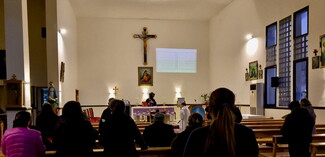
Alma al-Shaab’s residents come together for prayer on March 6, 2026. Alma al-Shaab, South Lebanon. (Photo courtesy of Rana Farah)
We were filled with fear that first night, on Wednesday. Thursday night was a little easier. We were all already so tired because nobody had slept the night before, so everyone slept early last night. Everyone finally slept. The exhaustion is more than just psychological and physical. You’re worried and anxious and have no idea what to do. And there’s absolutely no reassuring news. The only ones who try to reassure us are the UN; the unit nearest to us coordinates with the mayor and Father Maroun [Ghafari], a priest at the St. Mary parish. We didn’t really see UNIFIL on the ground except one time, when they brought things, snacks and such.
Every night is the same story. Every night we anticipate an Israeli invasion. We all gather in the church hall at 6 p.m., every day, and lock ourselves in until the morning.
Why did you decide to stay in Alma al-Shaab instead of leaving when the Israeli army was threatening the town?
Back in 2025, we did leave, and we returned only to find the Israelis had invaded and left our homes in ruin. We’ve spent the last year and two months rebuilding our homes and paying so much money to do so, all so we’re made to leave again? People say they would rather die here than leave their homes again. And anyway, where would we go? Some people have nowhere to go and can’t afford to rent a place. And we’re seeing what’s happening in Beirut… Maybe it’s safer here.
I’m here at the church with my parents and sister. The number of people gathering here is growing. Some people are even leaving Beirut and returning to Alma al-Shaab. There are families and children with us. The youngest of us is five years old and the eldest is 94.
There is a lot of anger at what is happening and who caused it. There is a lot of anger about why we have to keep doing this. My mother was seven years old the first time she was ever displaced, and now we’re displaced again. We have to leave every few years again. Every time, we have to live under gunfire and airstrikes. Today, there’s fear and concern: Are we going to be able to keep securing the things we need? Yes, we have some essential stockpiles, but how long is it going to last us?
The difference between the war and that of 2023 is that in 2023, most people left. There were only 80 people in the village, even before the war was in full swing. This time is different. We’re about 170. People who are ill or who have children have left. The difference is also our new mayor, who left Beirut and returned to stay here with the people. Our priest, too. They’re really standing by people, encouraging us to stay.
When we all made the same choice to stay, it reassured us — khalas, if we die, we die together.
That’s why we’re staying and sleeping in the church hall. It’s been hard. We don’t know if we’ll live to see the next dawn.
After a week of sheltering in place, news began to circulate that the community in Alma al-Shaab was going to be forced out of the town, escorted out by a UNIFIL unit, its soldiers walking ahead of and behind them to ensure their safety. We messaged to check in on Rana on March 6. When she didn’t respond, we reached out again. Finally, on Monday, March 9, Rana responded by saying that she and her family were okay and would likely evacuate the next day.
The mayor received a call from the Lebanese army that the ceasefire monitoring mechanism was asking the people of Alma al-Shaab to leave as soon as possible. There were a lot of arguments that night. Ten people wanted to stay, and they were arguing with the mayor that everyone must stay. Others wanted to leave. The mayor made it clear that the choice is theirs, but that staying was each person’s individual responsibility, considering the nearest hospital is 40 minutes away and the road there is far too dangerous. But when morning came, everybody was ready to leave. The 10 who had wanted to stay had a change of heart and left with everybody else.
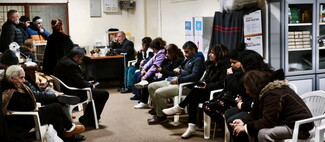
Father Maroun Ghafari on the phone in the hall of the St. Mary Church in Alma al-Shaab, where the town residents have been sheltering since Wednesday, March 4. March 9, 2026. Alma al-Shaab, South Lebanon. (Photo courtesy of Rana Farah)
Rana and her family were safely evacuated from Alma al-Shaab on Tuesday, March 10, and were displaced from their homes yet again. They are currently in Beirut. We spoke to her on Wednesday, March 11.
We’re broken. This is the third time we leave our village. This time, we’re not sure if we will ever return. We felt abandoned — the Lebanese army left us alone last Tuesday. Yesterday was the only other time we ever encountered UNIFIL, which is when they were escorting us out of the town. No one else was present, not even the army. No one but UNIFIL. We were protecting ourselves.
When Sami Ghafari* was killed by an Israeli drone, we asked UNIFIL and the Lebanese army to come and escort us to his burial, but they refused.
*Sami Ghafari, a 70-year-old resident, was killed by Israel in a strike on Sunday, March 8, while tending to his garden in Alma al-Shaab. He is the brother of Father Maroun Ghafari, who was mentioned earlier in this testimony as having gathered the residents of Alma al-Shaab in the church hall for safety.
On March 8, protesters marched through Hamra Street in Beirut, chanting in support of the resistance and demanding the Lebanese government do more to assist the hundreds of thousands displaced by Israel’s relentless assault on Lebanon. The demonstration was organized by a group of media professionals and journalists who are aligned with the Axis of Resistance.
Protesters carried portraits of their martyrs and of loved ones whom Israel kidnapped over the past two years and holds to this day. Many held signs that read, “The Lebanese state must shelter its own.” Marching together, they chanted, “We are the people who do not compromise. We will continue to resist.”
One demonstrator directed a message to families displaced by Israel, “Every part of this country is yours, every place is yours, every home is yours,” he said during Al Jadeed’s live broadcast.
Around 759,300 people have registered as displaced since the war escalated on March 2, according to the Lebanese government’s Disaster Risk Management Unit. As shelters fill and resources dwindle, families face an impossible choice: remain in their homes under Israeli bombardment or flee into the unknown, haunted by the prospect of never returning.
Last week, Israeli occupation forces issued sweeping displacement orders to everyone living south of the Litani River. The next day, they threatened the residents of Dahieh to leave their homes or face death, sowing panic that blocked traffic across the city and beyond. Similar orders have also been issued for parts of the Bekaa Valley.
“Where will they go?” Khalil al-Zain, a mukhtar in the city of Sour, told The Public Source. “People with big families and those who don’t have the means to flee will tell you that it’s more honorable for them to die at home.”
Over the past week, Israel carried out successive massacres in Lebanon. On March 8, Israeli warplanes targeted a three-story building in the al-Zuhur neighborhood in the southern town of Tuffahta, killing eight members of a single family. That same day, 20 people were martyred after the Israeli military struck a residential area in the town of Sir al-Gharbiyya, district of Nabatieh.
At the protest, demonstrators sharply criticized media outlets for both drawing a false equivalence between aggressor and defender and for providing limited coverage of Israel’s relentless attacks over the 15 months since the cessation of hostilities agreement was signed. For many, this silence amounts to complicity.
According to one organizer, the demonstration was also about reclaiming a voice “marginalized and hidden” by the mainstream press. “The media space is being closed off to us,” the organizer said, arguing that many outlets, driven by Gulf and Western funding, promote narratives that contradict the conscience of the Lebanese people.
“The new government is effectively shaped within an American framework,” said Mohammad, a resident of Dahieh who was present at the protest. In his view, public messaging reflects regional shifts, designed to weaken the resistance and its role within the Lebanese state. “Lebanese media has never been truly neutral,” he said. “Anti-resistance rhetoric has become much more visible compared to earlier wars.”
Khodor, a Lebanese activist at the protest, extended his criticism to government policy. He cited recent decisions — including the withdrawal of the Lebanese Armed Forces from southern villages rather than confronting Israeli soliders — as evidence of what he described as “clear American pressure.”
Organizers described the solidarity march as a diverse show of unity with the resistance that transcended sectarian divisions. Protesters framed their support as an important component of the defense against Zionist aggression, a way to “strengthen fighters on the front lines,” as one demonstrator put it, by showing that the home front rejects the “narrative of defeat.”
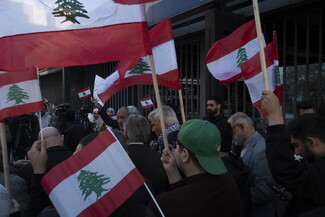
Protestors marching on Hamra Street carry flags, banners, posters, and photos of martyred and detained loved ones. Hamra Street, Beirut. March 8, 2026. (Fatima Joumaa/The Public Source)
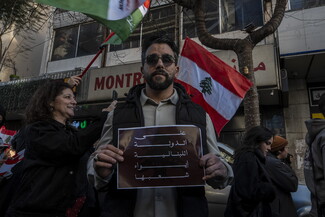
A survivor of the Israeli pager attack, Mohamad Halawi, participates in the protest. Hamra Street, Beirut. March 8, 2026. (Fatima Joumaa/The Public Source)
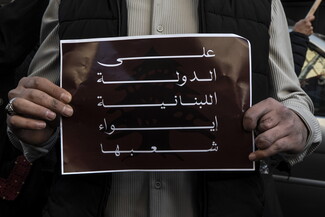
Halawi holds up a poster that reads: “The Lebanese state must shelter its own.” Hamra Street, Beirut. March 8, 2026. (Fatima Joumaa/The Public Source)
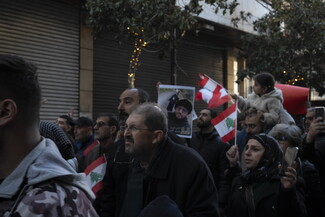
Participants of all ages march on Hamra Street, Beirut. March 8, 2026. (Fatima Joumaa/The Public Source)
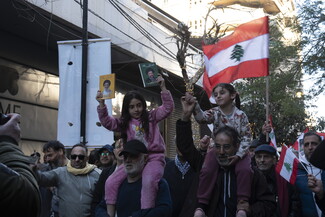
Participants hold up posters of martyrs and loved ones the Israeli occupation is holding captive in its detention centers. Hamra Street, Beirut. March 8, 2026. (Fatima Joumaa/The Public Source)
Dozens gathered in Beirut’s Riad al-Solh Square on the evening of March 6 to protest Israel’s ongoing aggression against Lebanon and the forced displacement of residents across the South and Beirut.
One demonstrator, carrying his young daughter, told Al-Akhbar newspaper, “We are staying, and we will remain, and we will teach our children that this is our country and that we will persist, despite the difficulties.”
Speakers said that since the so-called ceasefire agreement was signed in November 2024, Israel has continued its campaign of terror across the South, carrying out daily drone strikes, nighttime raids, and reconnaissance missions.
Political analyst Hosam Matar addressed the crowd, saying, “We are not second‑class citizens, and we are not sheep. Every person killed by Israel is worth this entire galaxy and everything in it.”
Israeli occupation forces have killed 217 people as of the evening of March 6, according to the Lebanese Ministry of Health.
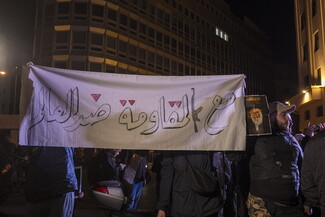
Beirut’s Riad al-Solh Square, facing the Grand Serail, filled with people who gathered in solidarity with the forcibly displaced and in protest of the state’s inadequate response. Protestors carried a banner that reads, “With the resistance against the world.” March 6, 2026. Riad al-Solh Square, Beirut. (Fatima Joumaa/The Public Source)
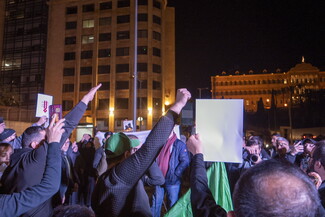
Protestors gather in solidarity with displaced southerners and to protest security forces’ efforts to re-displace them by forcing them out of the public spaces and public schools they are sheltering in. March 6, 2026. Riad al-Solh Square, Beirut. (Fatima Joumaa/The Public Source)
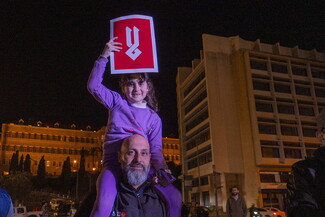
A demonstrator carries his young daughter on his shoulders. She is carrying a poster that reads: “No.” March 6, 2026. Riad al-Solh Square, Beirut. (Fatima Joumaa/The Public Source)
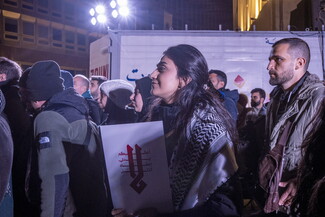
Demonstrators rally against Israeli occupation forces’ continued aggression against Lebanon and the forced displacement of residents south of the Litani River and Dahieh. The poster in the image reads: “No.” March 6, 2026. Riad al-Solh Square, Beirut. (Fatima Joumaa/The Public Source)
Earlier today, the Israeli occupation forces issued a forced displacement order to all the residents of Dahieh, threatening their lives if they do not leave the southern suburbs immediately.
This is the first time that such an order designates the entirety of Dahieh, along with adjacent municipalities, as a site for bombardment.
The order came with instructions on which roads to take, threatening against evacuating further south. Residents of Burj al-Barajneh and Hadath were forced to go east, while residents of Haret Hreik and Chiyah were forced to go north — a move widely understood as a means to stoke internal strife.
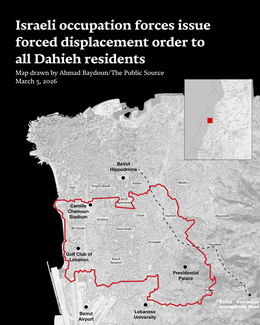
On March 5, 2026, Israeli occupation forces issued a forced displacement order to all residents of Beirut's southern suburbs, threatening the lives of around 700,000 people. (Map by Ahmad Baydoun/The Public Source)
Dahieh is home to around 700,000 people, some of whom might be unable to leave due to old age or disability, while others may refuse to abandon their homes. Those who try to leave, however, find themselves caught on jam-packed roads, in their cars or on foot, with no guarantee of shelter.
Starting on March 2, Israeli occupation forces similarly issued several forced displacement orders to everyone living south of the Litani River — to over 100 towns and villages — forcing hundreds of thousands to flee their homes, give up their lands, and move north of the river, or risk death.
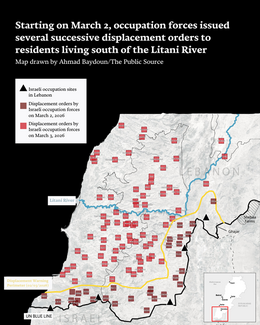
A map showing the area in southern Lebanon that Israeli occupation forces have repeatedly tried to forcibly empty. (Map by Ahmad Baydoun/The Public Source)
Israel is enforcing the Gaza Doctrine: Forced mass displacement of civilian populations, ethnic cleansing, and genocide.
Israeli Finance Minister Bezalel Smotrich threatened in a video shared across social media: “Beirut’s southern suburbs will soon look like [Gaza's] Khan Younis.”
Thousands of Hezbollah supporters wept and swayed to Hussaini lamentations at a gathering in Dahieh’s Ashoura Square on Sunday, March 1, mourning Iran’s Supreme Leader Ayatollah Sayyed Ali Khamenei. Their cries grew louder each time someone invoked the name of Sayyed Hassan Nasrallah, whose image rose above the mourners’ heads as chants echoed through the square. For many supporters of the resistance group, the wound of their leader’s martyrdom has yet to heal.
Fasting crowds of mourning men, women, children, and the elderly — all clad in black — marched toward the square from the early morning hours. They carried pictures of Khamenei pressed to their hearts. Joined in chest-beating rituals, waving the flags of Hezbollah and Iran, they chanted: “We will never accept humiliation.” By 4 p.m., Jamous Street was almost completely blocked. The sound of weeping moved through the gathering to the backdrop of the hymn, “Farewell, Our Father.”
Among the women, one voice soared above the others: “Stop your wailing and praise God from the depths of your hearts, with all your strength. We will be victorious; we will break their power.” She then cried, “Death to Israel and death to America” — a slogan repeated by those around her.
Attendees perceived the U.S. and Israel’s assassination of Khamenei on February 28 as an attack on a large segment of the global Muslim population, particularly the Shia community, their own. For many of the late leader's admirers and followers, national borders mean little when religious leadership is under assault. The U.S.-Israeli assassination of the Ayatollah was not merely an attack on a political figure. For many, it was an attack on a spiritual, communal, and transnational leader.
Khamenei is known among his supporters for his simple and ascetic life, which reflected his rejection of consumerist capitalism. In his youth, he and his family endured significant material hardship. In a 2013 post on X, he recalled: “I remember those nights when there was nothing to eat. My mother struggled to prepare dinner, and there was only bread and raisins.”
In spite of escalating U.S. threats against Iran in the days leading up to the latest U.S.-Israeli war, Khamenei continued attending nightly Qur’an recitations during Ramadan. This display of spiritual resolve perplexed members of U.S. President Donald Trump’s administration, who wondered publicly why the Iranian leader had not sought refuge.
Following the official announcement of Khamenei’s martyrdom, resistance factions across the region issued statements mourning the leader and reflecting on the support and guidance he had provided their movements. Among them were the Izzeddin al-Qassam Brigades, who described him as a principal supporter of the Axis of Resistance.
Iran has historically supplied the resistance in the Gaza Strip with arms and military training, enhancing their ability to conduct high-profile operations against the Israeli occupation. Iranian support has been vital for the development of Gaza’s extensive tunnel network, for example, which enabled the resistance to persevere despite the ongoing siege on the Strip.
As the gathering in Khamenei’s honor came to an end, mourners slowly dispersed from Ashoura Square. Many appeared dissatisfied, as though the scale of the gathering had not matched the depth of their anger.
Later that night, Hezbollah launched retaliatory rockets against Israel’s military infrastructure — a first since the ceasefire agreement in November 2024. In a statement following the operation, the group said it targeted the Israeli Mishmar HaCarmel missile defense site south of Haifa with a barrage of precision rockets and drones. Hezbollah framed the operation as a response to the "enemy’s daily attacks against the South."
Over the past year and a half, the Zionist entity has violated the ceasefire agreement more than 15,400 times. Since at least March 1, prior to the rocket launch, 100,000 Israeli occupation soldiers had been deployed across the border. The resistance group characterized the rocket launch as defensive, in anticipation of a broader Israeli aggression.
In his first speech since the operation, Hezbollah Secretary General Naim Qassem said on Wednesday, “To those who ask why at this precise moment, I ask them: Do you want us to wait indefinitely?” He continued sharply, “Resistance is a right that we will not negotiate with anyone.”
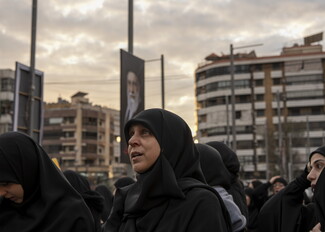
Gaze to the sky, a woman prays and chants, a large poster of the martyred Khamenei raised high behind her. Ashoura Square, Dahieh, Lebanon. March 1, 2026. (Fatima Joumaa/The Public Source)
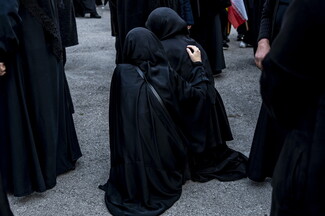
At the heart of the crowd of women, two sit crouched, huddled together and soothing one another. Ashoura Square, Dahieh, Lebanon. March 1, 2026. (Fatima Joumaa/The Public Source)
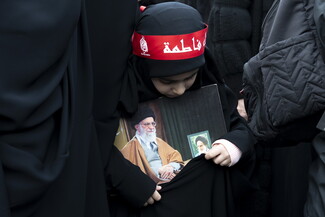
A young girl clutches a photograph of Imam Khamenei seated by a portrait of Imam Khomeini. A red headband from Imam Reza’s shrine adorns her head. It reads: “Sons of Fatima.” Ashoura Square, Dahieh, Lebanon. March 1, 2026. (Fatima Joumaa/The Public Source)
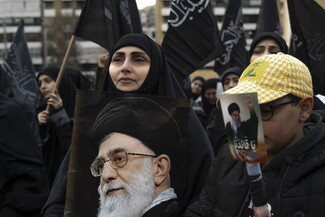
A woman looks onward as she carries a portrait of the martyred Supreme Leader close to her chest. Her son stands beside her, wearing a yellow Hezbollah cap and carrying a poster of Khamenei raising his fist, with the words “Oh our leader!” printed on it. Behind them, women raise black banners inscribed with “Oh Zainab the Great.” Ashoura Square, Dahieh, Lebanon. March 1, 2026. (Fatima Joumaa/The Public Source)
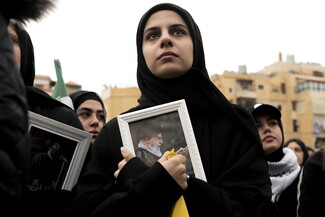
A woman holds a framed photograph of the late Ayatollah praying, pressing the image to her chest with one hand. She tightly holds a yellow Hezbollah sash with the other, her gaze fixed forward as she listens to the chanters. Ashoura Square, Dahieh, Lebanon. March 1, 2026. (Fatima Joumaa/The Public Source)
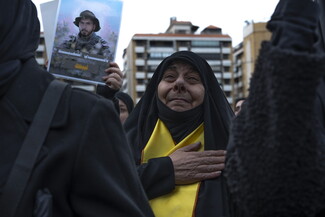
Clad in black, an elderly woman weeps as she beats her chest with her right hand, a Hezbollah sash wrapped around her shoulders. To her left, a hand lifts a photograph of the fighter Hassan Hamid (Abu Turab), martyred in the 66-Day War, marked with the words: “With my brother's martyrdom, I am at your service.” Ashoura Square, Dahieh, Lebanon. March 1, 2026. (Fatima Joumaa/The Public Source)
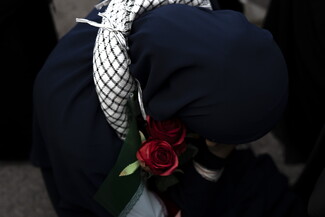
Dressed in black, a woman sits on the floor during a gathering paying tribute to the martyred Supreme Leader of Iran Sayyed Ali Khamenei. She weeps quietly, her head bowed in grief, an Iranian flag wrapped around her arm. Ashoura Square, Dahieh, Lebanon. March 1, 2026. (Fatima Joumaa/The Public Source)
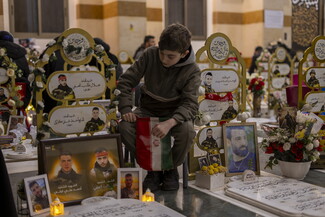
Holding the Iranian flag, a young boy sits in silence beside the graves of martyred resistance fighters Jalal Taleb al-Affi “Mohammad Ali” and Hajj Ahmad Ali Karaki “Jihad” at the Rawdat al-Hawraa Zainab military cemetery. Dahieh, Lebanon. March 1, 2026. (Fatima Joumaa/The Public Source)
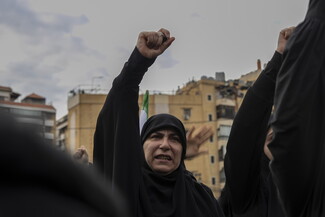
A woman raises her fist to the sky and chants with the crowd, a digital tasabih visible on her finger. Ashoura Square, Dahieh, Lebanon. March 1, 2026. (Fatima Joumaa/The Public Source)
Share this page