Beirut Marches for the Displaced: “The Lebanese State Must Shelter Its Own”
On March 8, protesters marched through Hamra Street in Beirut, chanting in support of the resistance and demanding the Lebanese government do more to assist the hundreds of thousands displaced by Israel’s relentless assault on Lebanon. The demonstration was organized by a group of media professionals and journalists who are aligned with the Axis of Resistance.
Protesters carried portraits of their martyrs and of loved ones whom Israel kidnapped over the past two years and holds to this day. Many held signs that read, “The Lebanese state must shelter its own.” Marching together, they chanted, “We are the people who do not compromise. We will continue to resist.”
One demonstrator directed a message to families displaced by Israel, “Every part of this country is yours, every place is yours, every home is yours,” he said during Al Jadeed’s live broadcast.
Around 759,300 people have registered as displaced since the war escalated on March 2, according to the Lebanese government’s Disaster Risk Management Unit. As shelters fill and resources dwindle, families face an impossible choice: remain in their homes under Israeli bombardment or flee into the unknown, haunted by the prospect of never returning.
Last week, Israeli occupation forces issued sweeping displacement orders to everyone living south of the Litani River. The next day, they threatened the residents of Dahieh to leave their homes or face death, sowing panic that blocked traffic across the city and beyond. Similar orders have also been issued for parts of the Bekaa Valley.
“Where will they go?” Khalil al-Zain, a mukhtar in the city of Sour, told The Public Source. “People with big families and those who don’t have the means to flee will tell you that it’s more honorable for them to die at home.”
Over the past week, Israel carried out successive massacres in Lebanon. On March 8, Israeli warplanes targeted a three-story building in the al-Zuhur neighborhood in the southern town of Tuffahta, killing eight members of a single family. That same day, 20 people were martyred after the Israeli military struck a residential area in the town of Sir al-Gharbiyya, district of Nabatieh.
At the protest, demonstrators sharply criticized media outlets for both drawing a false equivalence between aggressor and defender and for providing limited coverage of Israel’s relentless attacks over the 15 months since the cessation of hostilities agreement was signed. For many, this silence amounts to complicity.
According to one organizer, the demonstration was also about reclaiming a voice “marginalized and hidden” by the mainstream press. “The media space is being closed off to us,” the organizer said, arguing that many outlets, driven by Gulf and Western funding, promote narratives that contradict the conscience of the Lebanese people.
“The new government is effectively shaped within an American framework,” said Mohammad, a resident of Dahieh who was present at the protest. In his view, public messaging reflects regional shifts, designed to weaken the resistance and its role within the Lebanese state. “Lebanese media has never been truly neutral,” he said. “Anti-resistance rhetoric has become much more visible compared to earlier wars.”
Khodor, a Lebanese activist at the protest, extended his criticism to government policy. He cited recent decisions — including the withdrawal of the Lebanese Armed Forces from southern villages rather than confronting Israeli soliders — as evidence of what he described as “clear American pressure.”
Organizers described the solidarity march as a diverse show of unity with the resistance that transcended sectarian divisions. Protesters framed their support as an important component of the defense against Zionist aggression, a way to “strengthen fighters on the front lines,” as one demonstrator put it, by showing that the home front rejects the “narrative of defeat.”
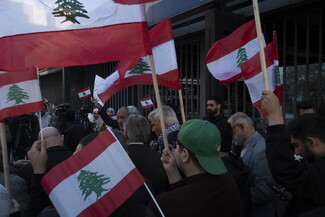
Protestors marching on Hamra Street carry flags, banners, posters, and photos of martyred and detained loved ones. Hamra Street, Beirut. March 8, 2026. (Fatima Joumaa/The Public Source)
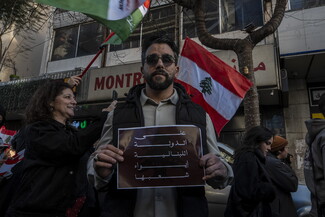
A survivor of the Israeli pager attack, Mohamad Halawi, participates in the protest. Hamra Street, Beirut. March 8, 2026. (Fatima Joumaa/The Public Source)
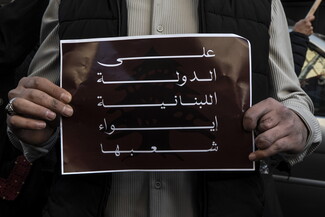
Halawi holds up a poster that reads: “The Lebanese state must shelter its own.” Hamra Street, Beirut. March 8, 2026. (Fatima Joumaa/The Public Source)
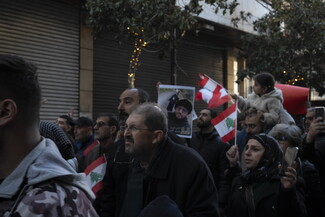
Participants of all ages march on Hamra Street, Beirut. March 8, 2026. (Fatima Joumaa/The Public Source)
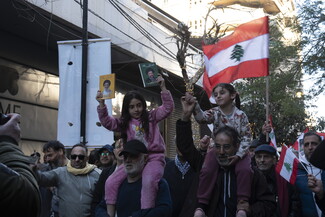
Participants hold up posters of martyrs and loved ones the Israeli occupation is holding captive in its detention centers. Hamra Street, Beirut. March 8, 2026. (Fatima Joumaa/The Public Source)
Share this page