
A Popular Front of Grandmothers
Dear Mohammed,
Today, June 25th, I buried my grandmother in Tehran early in the morning, before the hot summer sun hit us, at Behesht-e Zahra Cemetery. She passed away naturally at the end of the 12th day of war, after 99 years of life. Strangely, the final days of her life were joyful for us. Because of the war, we were all gathered in one place, and despite the sound of the bombs, she was in good spirits. We even managed to travel together. She saw mountains, rivers, and her favorite flower, shaghayegh (corn poppy), after so many years of being housebound in her apartment in Tehran.
On the way back from the cemetery, one day after the ceasefire, I realized that, during the burial, I had repeatedly merged images of your grandmother with my own. I don’t know how this happened — perhaps it was the effect of the bombs or their lingering vibrations, or a deeper association that made me write this letter to you.
Our internet was cut off for four days. There was no news about Palestine, neither on domestic television nor on foreign Persian-language satellites. The entire movement I had been following independently for the past twenty months — and for years before that — became abruptly inaccessible to me. On Persian satellite channels, the focus shifted to nuclear energy and Iran’s relations with the West. On domestic channels, “national strength” dominated the news cycle. But in the midst of the internet blackout and the sound of bombs, Gaza suddenly felt very close. We recognized the sound of drones from the videos we had seen of Gaza. And thanks to the Palestinian people, we already knew the identity of the monster attacking us.
But what happened at the cemetery was something else entirely. During my grandmother’s burial, I remembered a grandmother in Sheikh Jarrah whom I had drawn four years ago while staying in a mountain house. I didn't have good internet access then either. When I checked the news in a local café, I learned about the new wave of intifada in Palestine starting in Sheikh Jarrah. I returned to my mountain house determined to create something for the movement, so I worked from memory. I had been drawing for Palestine since I was very young, not because of state propaganda, but because of my family’s leftist politics. Despite the crackdown on leftists in the first decade after the revolution, our house was filled with political and internationalist cultural materials, and I had grown up drawing for Palestine.
That day, I tried to recall the neighborhoods of East Jerusalem. Vague images came to me of an elderly woman sitting on a plastic chair in front of her home. I completed the illustration with the Arabic slogan “لن نرحل” (We will not leave), which I had seen briefly online. After coloring it on my computer, I posted it on Instagram.
The next day, when I returned to Tehran, I saw my illustration in a protest in Ramallah. I was happy my lines and colors had reached Palestine. One caption said it depicted the grandmother of the el-Kurd family. A quick online search confirmed it: the woman I’d drawn from memory was indeed your grandmother. Later, I read about your connection to your grandmother, how unique, and yet so deeply familiar, that bond was, dear Mohammed.
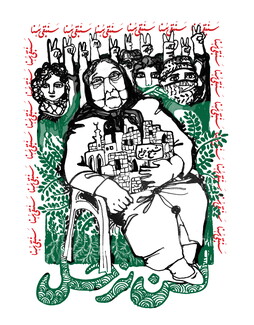
“We Will Not Leave,” illustration by Golrokh Nafisi.
During these twelve days of war, I often thought about the things you’ve written — especially your stance against turning the oppressed into saintly, flawless, and perfect victims. I want you to know that your words cut through the terrifying darkness like guiding lights. Especially as some diaspora Iranians — well-meaning, so long as they weren't pro-war — once again tried to convince the white world that not all Iranians are savages or backward! In those moments, while spending time with my grandmother, it was your references to your grandmother — the woman leaning in front of her home — that pointed me toward something deeper, lighter, and stronger. Her presence stood in quiet defiance of the desperate performance of innocence. She spoke instead in a language of dignity and of resistance.
While Iranian intellectuals, peace prize winners, thinkers, and artists were busy writing convoluted statements blaming both sides for the eruption of war, my grandmother — in the vulgar curses she hurled at Netanyahu as we carried her wheelchair up four flights of stairs — would note at the top of the staircase: “If he did one good thing in his life, it was finally getting me to your house!” Later, when people were worried which part of Tehran had been hit, she leaned in quietly over and asked:
“Where did we hit?”
Like many Iranians who are politicized by major historical events, my grandmother’s politics were shaped by the nationalization of oil in Iran and by living in the company housing of the oil fields in the south. Her worldview had one unwavering core: opposition to colonialism. Even when anti-colonial ideas lost popularity in Iran, she stood firm because of her personal experiences. “I lived with them. I know them,” she frequently explained.
In recent years, when most Iranians turned their attention to fighting domestic tyranny and became convinced that anti-imperialist attitudes are just state propaganda, the words of my grandmother, or Mama as I used to call her, didn’t sit well with many. Even family members saw her staunch anti-colonialism as part of our misfortunes, as too much antagonism toward the world. The era of diplomacy, peace, and compromise had supposedly arrived — but Mama didn’t care. In true southern Iranian style, she raised the banner of anti-colonial struggle proudly and defiantly.
She wasn’t sentimental. She had no spiritual beliefs. We used to joke that she was the most materialistic member of the family. Nothing spiritual ever took the place of her passion for the concrete, the detailed, the physical. And her love for objects. She adored her kitchenware, especially her baking tools. But she was emotional in her politics. Over the past two years, many times with tears in her eyes, she told me she was praying for Palestine, praying for Gaza.
Dear Mohammed, your reference to your grandmother and your insistence on a simple language of resistance, free from elite academic jargon, reminded me of my own grandmother’s clarity. She never read anti-colonial theory, but she — in her honest southern accent — would say, “I lived with them.” She spoke of oil as anything extracted from the land, and of its thief as a thief of the land: colonialism. It was this spirit that kept her deeply connected to Palestine until her very last day.
All these years, while trying to counter the Persian-speaking world’s indifference to Palestine, I never realized how complicated my language had become. I never noticed how I had wrapped myself in a cocoon of complexity — constantly disavowing our state’s propaganda first, then explaining that my Palestine was not their Palestine — just to reach a sympathetic listener. But during those twelve days, returning to my grandmother’s language, cursing those sending bombs to our house, meant returning to a simplicity that set my voice free.
When I first encountered the Palestinian Oral History Project at a conference in Beirut, I felt something similar. Beyond the personal stories of the first generation of the Nakba, what moved me was the simplicity of their language — a language shared across generations throughout the region. Regardless of class, status, or gender, their stories formed a popular front against colonialism. A front that, over time, was suppressed and diminished throughout the region, crushed by the tyranny of regimes that turned anti-colonial struggle into a foundational principle or by suppressing the people’s fight in alliance with the empire. Later, as we tried to free ourselves from our own corrupt regimes, the simple, radical language of our grandmothers’ struggle was fed into the vast machinery of Western cultural institutions. There, it became the jargon of abstract art and obscure discourse — churned out endlessly for libraries, biennials, and conferences. But it never became popular.
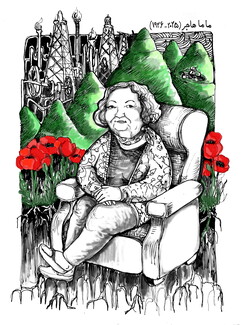
“Mama Hajar,” illustration by Golrokh Nafisi.
Dear Mohammad, it wasn’t an accident that your grandmother appeared once in the mountains of Alborz and again at my grandmother’s funeral. This connection isn’t just sentimental — grandmother, home, soil — it’s also strategic. In the terrifying clarity of bomb blasts, and during those six final days I spent with her, a political roadmap emerged: a path for the expression of my political feeling in a simple, direct language.
When I first started studying at an art academy in Amsterdam, one of my professors left a strange comment in my first year critique: “Golrokh, you still haven’t learned to navigate between radical political ideas and a grandmotherly aesthetic of knitting and baking cakes. You haven’t found your voice yet.” But, I responded, my grandmother had radical politics — she was known in our family for being defiant. My professor laughed and said, “That’s exactly your problem, you’re misplacing your activist spirit onto your grandmother’s stubbornness.”
He clearly didn’t understand anti-colonial struggles in our region, which had been shaped by our grandmothers on a broad front. But you, dear Mohammed, know better than most that stubbornness can be a political stance — a strength you’ve clearly inherited from your grandmother.
I was often called paradoxical in the European art scene for combining what liberal logic insists must remain separate. I often faced the critique that my work carried irresolvable contradictions. But the point where politics and art met in my work was exactly where they should have been distinguished from each other. In their way, everything had to be separated: our politics had to be simplified to its boundaries of ineffectiveness only to later transform, through a highly complex and personal language, into art.
Now, war, my grandmother’s death, and the sudden reappearance of a grandmother in Sheikh Jarrah have brought me clarity again. After fifteen years, I finally know how to respond to that professor.
Returning to our grandmothers’ language isn’t a romantic longing for home. It’s a return to a radical, simple language capable of building a popular front of resistance. The “people’s language” of our grandmothers isn’t the watered-down populism we see today, aimed at the lowest common denominator. It means using crystal clear words to shape a shared, radical horizon.
So I think I was right, during my grandmother’s burial, to recall the woman leaning on her chair in Sheikh Jarrah — not just as someone defending her neighborhood, but as the grandmother of all of us. And by returning again and again to the vast popular front, we’ll find our collectiveness anew, every day.
Mama’s view of life won’t let me believe that war defeated her. On the contrary, being with her exhausted body and sharp, simple language during the war revealed another kind of resistance — one I now want to find in my own body. It is a resistance so deep it fills every cell, yet so light it lets even the shockwave of a bomb pass through you without making you tremble. The rotting empire of money, power, and the military-industrial machine does not shake the bodies of our grandmothers, even when they are resting in their soil. They drive our roots deeper into the earth, into depths no bomb will ever reach.
At the cemetery, as a farewell, I promised her to never stop drawing and dreaming about a free Palestine, and to defend her vision of independence for our homeland with everything I have.
Dear Mohammad, I hope that one day in the future we will meet — perhaps in East Jerusalem, or in my grandmother’s neighborhood in Tehran, where the windows of the houses carry the scent of the diverse spices of immigrants from different parts of Iran. Houses far from their own homes in Haifa and Masjed Soleyman. In that meeting, we will likely recall the expressions, jokes, and curses of Hajar and Rifqa, which, mingled with the scent of jasmine and the aroma of walnut cake, will become the unwavering will for justice and freedom that fuels our journey in this global movement.
In solidarity with you and with Palestine more than ever,
Golrokh
Tehran
June 25, 2025
Share this page