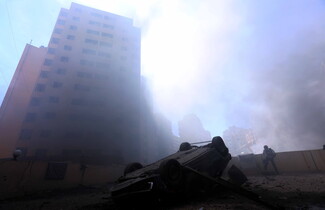
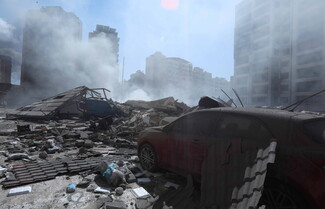
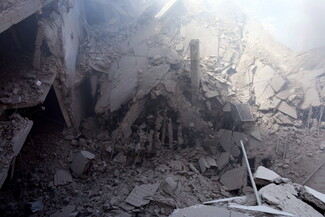
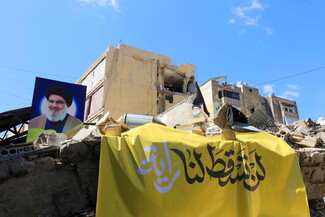
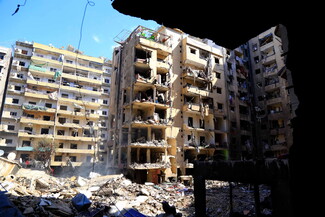
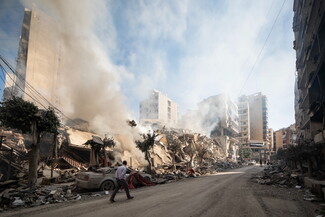
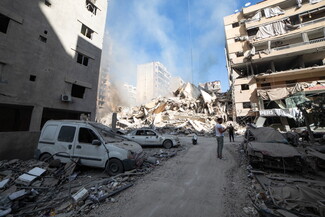
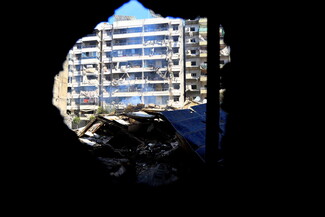
Amid the continuous Israeli bombardment of Lebanon, Dahieh has suffered widespread destruction to its dense urban fabric, where hundreds of thousands of people live, work, eat, and sleep. On Wednesday, October 2, 2024, Hezbollah invited the media to examine the aftermath of recent Israeli strikes, as many of the affected sites had previously been difficult to access. The Public Source saw entire building complexes reduced to rubble by Israeli missiles, which Israel claims – implausibly – were targeted strikes on Hezbollah’s military infrastructure. In October 2008, Israel officially outlined what is now known as the “Dahieh Doctrine,” a tactic developed during its 2006 war on Lebanon. The doctrine involves the large-scale destruction of civilian infrastructure in neighborhoods that support the resistance, with the aim of forcing the population into submission. While Israel asserts that this strategy is intended to degrade Hezbollah’s capabilities, its implementation primarily affects key civilian infrastructure and is a violation of international law.
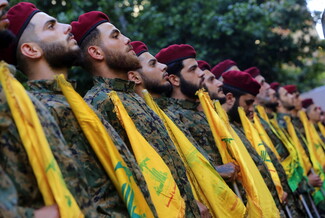
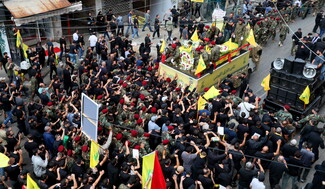
Hezbollah fighters stand at attention at the funeral of Radwan Force commander Ibrahim Aqil on Sunday, September 22, 2024 in Beirut's southern suburbs. (Marwan Bou Haidar/The Public Source)
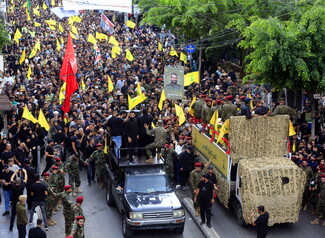
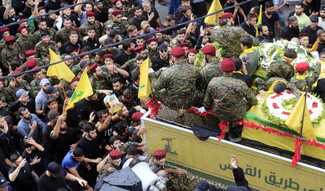
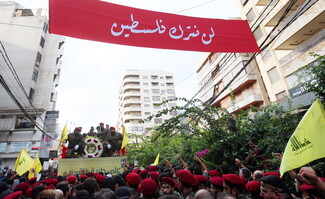
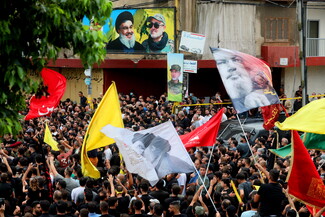
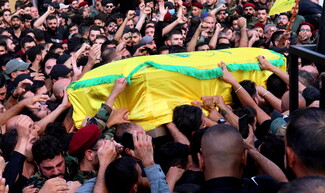
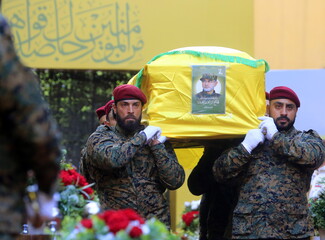
Fists of resolve rise in the air and handfuls of rice fall on the coffin. Under the banner, “we will not abandon Palestine,” mourners, in their hundreds, if not thousands, assemble for the funeral of senior Radwan Force commander Ibrahim Aqil, on Sunday, September 22, 2024 in Dahiyeh, Beirut’s southern suburb.
The martyr had been part of the resistance since its founding in the wake of the Israeli invasion of Lebanon in 1982. Through the ‘80s and ‘90s, Aqil was a field commander in the struggle to liberate the South, and in 2006, he lent his long experience to foil Israel’s attempt to re-invade and occupy. Decades of his life were dedicated to training fighters and ensuring readiness and continuity for the resistance. In 2006, he formed Hezbollah’s elite unit, the Radwan Force, which he led until his martyrdom. On September 20, Israel assassinated him for honoring a principled, military commitment to the resistance in Gaza and the liberation of Palestine.
In the same attack that afternoon, Israel killed at least 31 people and injured 68, according to the Public Health Ministry. An F-35 struck two apartment buildings as families gathered for lunch or returned home from work or school.
Translated by Ahmad Elamine
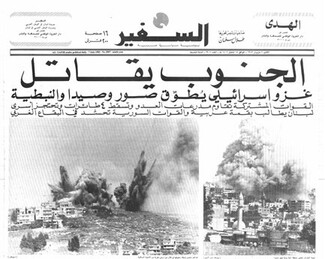
Front page of Assafir, "The South Fights: Israeli Invasion Encircles Sour, Saida, and Nabatieh." 1982. (Photo Credit: Assafir newspaper)
Contact us if you’d like to make critical contributions to our coverage of Israel’s latest war on Lebanon — and all forms of resistance against it.
In June 1982, Israel invaded Lebanon and occupied south Lebanon. After 18 years of brutal occupation, Israel suffered a historic defeat, the first in the Zionist entity’s history, and was forced to withdraw, humiliated. Six years later, in July 2006, Israel waged another war against Lebanon. For 33 days, it sought to occupy parts of South Lebanon — and for 33 days, it failed. Despite repeated attempts to re-establish its control over the land, Israel was once again forced to retreat, suffering the second defeat in its entire history, both times on the same stubborn soil of south Lebanon.
Over the past month, Israeli officials have expressed fantasies of reoccupying south Lebanon. For us, the future seems to be uncertain and indeed much of it is. One thing is certain, however — they will be defeated. Forty-two years ago, in a roundtable journal organized by al-Tariq magazine, Hassan Hamdan, known as Mahdi Amel — a Marxist philosopher and militant from south Lebanon — warned against acquiescence and pessimism of the intellect and will. With unwavering intellectual clarity, even amid war, and unyielding political militancy, even in seemingly desperate times, Amel articulated the guiding principle that continues to shape Lebanon’s present and future as a bastion of resistance — a node that both haunts and breaks Israel.
Ahmad El-Amine, a Lebanese-British doctor working in Psychiatry in London, translated Mahdi Amel’s The Path of Revolution in Lebanon is Our Universe (al-Tariq, 1982):
“The logic of history dictates that it must follow the path of struggle—against the invaders in Lebanon and against all tyrants from the ocean to the gulf. History has always progressed through the logic of this struggle. They plot, but their plots will turn against them.
On the surface, they seem to be in control of events: initiating, destroying, and seeking revenge. They besiege the land, sea, and sky, championing death. Yet, in our eyes, death will besiege them from every corner in the forthcoming era.
They claimed the war in Lebanon would be swift. They said that in just a few days, those who had not yet knelt, who only understand the language of force, would finally kneel. They declared that there would be no Salaam, only Shalom, and that Israel is the Rome of our day. To the kings of Israel and their imperialist masters—the masters of the foul regimes in our Arab world, to the petty fascists—we say: It pleases us to spit in your faces. We will fight you even with our nails. Our fists are the compass of history, and the bullets of our freedom will pierce your hearts that beat death inside your ribs. To you, we say: Brick by brick, we will build a world on your filthy graves. You are the dustbin of history, and Beirut is the city of the free who have made a vow: We will resist you.
This is our guiding principle: No to fascism. The path of revolution in Lebanon is our universe. From our defiance, a beautiful morning will rise, as we champion it now, in this very moment, now, now, now—and it will triumph through us.”
Contact us if you’d like to make critical contributions to our coverage of Israel’s latest war on Lebanon — and all forms of resistance against it.
On September 12, 2024, during a Twitter live broadcast, health researcher Dr. Layth Hanbali calmly cited a shocking fact: Israel’s war on Gaza has led to around 11,000 Palestinian children losing limbs. “This is the largest cohort of pediatric amputees in the history of warfare,” he said. “On a clinical level, it's critical to try and understand the health implications of such a calamity.”
This new calamity is part of an old practice: mass maiming as a deliberate strategy of state violence. For almost two years, beginning in 2018, the people of Gaza walked every Friday to the border fence with Israel, demanding an end to Israel’s blockade of Gaza, and the right to return to their homes, in a series of nonviolent demonstrations called the Great March of Return. During this time, Israel’s military specialized in shooting protesters in the legs, knees, and ankles. “At first we told them to shoot at the leg,” said one officer quoted in the Israeli newspaper Ha’aretz. “We saw that you could be killed like that, so we told them to shoot below the knee. Afterward, we made the order more precise and instructed them to shoot at the ankle.”
After last week’s pager and two-way radio attacks, as people in Lebanon wondered whether it was safe to even call their loved ones, pro-Israel social media accounts erupted with a celebration of maiming: grisly jokes and memes gloated over severed limbs, exploding phones, and supposedly neutered men. To put the pager attacks in the context of Israel’s ongoing practice of maiming, The Public Source reached out to Jasbir K. Puar, a professor of Global Race Studies at the University of British Columbia and author of the award-winning book “The Right To Maim: Debility, Capacity, Disability.”
We wanted to hear her thoughts on the pager and radio attacks, in which thousands of people lost hands and eyes in a split second. How might these attacks complicate the typical framing of liberal humanitarianism, which presents such attacks as more “humane” than outright killing? How does this new spectacle of horror fit into Israel’s “humane” image, which has long been central to its justification for the right to maim?
Below is her response, edited lightly for length and clarity.
Jasbir K. Puar:
These detonated explosions of hand-held devices maim on several levels: bodily, as events of mass impairment that will likely lead to hundreds of permanent disabilities, some of them preventable with proper medical care, which may not be available (please note I use the term disability loosely, as it invokes a liberal rights apparatus that Palestinians — and now, perhaps, the Lebanese — cannot avail themselves of); infrastructurally, as medical facilities are pushed beyond capacity, overwhelmed with injured patients needing emergency care at exactly the same moment, an impossible scene of treatment; psychically, as people in Lebanon walk in fear and terror of the next event, and a global audience ponders how else and where else such tactics might be used; and communally, as a short-circuiting of communication through social media and messaging platforms render people cut off from local and diasporic connections, isolated in their terror.
The simultaneity of the explosions, yet dispersal of the injuries, seems significant in a spatio-temporal sense: a kind of distributed, spatially diffuse massacre.
I always understood the "right to maim" as broadly relevant to any context where "not-killing" is proffered as a "humane" alternative to contain and control bodies — in effect authorizing less harm vis-à-vis killing, but a greater, ever-expanding scope of violence. We see this with the logic of non-lethal weapons, which are narrated as instruments that avoid mass killing — but in fact therefore allow greater usage of these weapons to harm, to debilitate, to maim. During the George Floyd protests we saw a proliferation of "crowd control weapons" (CCWs) used to attack protesters, with police forces shooting rubber bullets into protestors’ eyes (in France, the U.S., Chile, and many other locations; there is also long-standing practice of security forces shooting pellets at the eyes of people in Kashmir). The right to maim is by no means tethered to Israel, even as Israel might be an exemplar of its praxis.
I agree that the framework of liberal humanitarianism is not needed as cover for Israel's heinous acts of violence in this instance, nor in the genocide on Gaza. Instead, I think the right to maim is functioning as South African Advocate Tembeka Ngcukaitobi explained, in the testimony he delivered at the International Court of Justice hearings in January, where he stated that Israel will maim “what it cannot destroy.” In prior iterations the “cannot” was about the restraint of force or the appearance of disproportionate force. But now the “cannot,” both in Gaza and Lebanon, appear to be about logistical constraints; and in that sense, it might be perhaps only a marker of time (“we cannot yet”). The recent horrific attacks on southern Lebanon and in Beirut, killing hundreds of people, indicate that the right to maim and the right to kill are no longer in a supplementary relation — one modulating or covering for the other — but rather, both are explicitly enacted as strategies of violent decimation.
In instances past, maiming was a tactic to minimize death — placating global actors, while nevertheless creating huge harm through mass impairment. The tactic was explicit at times (during the first intifada) and covert at other times (the number of injured in Israel’s 2014 Gaza War, for example, was rarely noted, as there was so much grief about the number of dead). In this case I think the nature of the spectacle — which involves, as you note, the fetishization of dismembered body parts — is crucial, because it is tutoring international audiences in the value hierarchy between Israeli and Palestinian and Lebanese bodies. It appears akin to the mass injuries sustained during the 2018–2020 Great March of Return, during which western mainstream media routinely printed images of rows of Palestinian men with amputated legs, in wheelchairs, and bandaged and on crutches. Through this spectacle, the amputated limb had become a signature injury, a carceral assemblage of the “humanitarian” use of maiming, the media focus on disaster capitalism, and the tactical attempt to contain resistance. Signature injuries are, to some extent, biopolitically preordained: a particular injury becomes what a certain body is known for, what it is expected to receive and assimilate, even before it happens to the body.
I feel that what is being normalized is the mass impairment, through the most horrifying dismemberment of body parts, of Palestinian and now Lebanese bodies, as the value of these bodies, as what these bodies deserve and are destined for. In that sense, the humanitarian rationale is no longer needed — only the collective witnessing, tutoring, absorption, and sanctioning of a global audience that is only too happy to have their racist anti-Arab, anti-Palestinian world views confirmed. It is as if to say: if these bodies are to remain alive, they must only be alive as mutilated.
Contact us if you’d like to make critical contributions to the coverage of Israel’s latest war on Lebanon — and all forms of resistance against it.
On Tuesday, September 17, at 3:30 p.m., as children were arriving home from school, the state of Israel sent messages to thousands of pagers, allegedly belonging to members of Hezbollah, across Lebanon. As thousands of hands fished pagers out of pockets and held them up to their faces — and, in one case, as a ten-year-old girl ran to bring the pager to her father — the devices exploded. The detonations killed 12 people, including two children, and left 2,800 others with injuries, many of them grave. The next day, handheld radios across Lebanon detonated simultaneously at around 5:00 p.m., during the funerals for those killed the previous day. The second round killed 20 and wounded over 450.
Over the next few days, doctors performed thousands of surgeries. As of today, some of the wounded were still waiting for their turn in hospital queues. Others were transferred to hospitals in Damascus and Tehran.
An overwhelming majority of the injured had mangled hands, said Ghassan Abu Sitta, the renowned British-Palestinian plastic and reconstructive surgeon, who flew to Lebanon immediately after the Tuesday massacre. A significant number of them needed amputations.
Many also sustained eye injuries that led to loss of vision. “It’s a nightmare,” said ophthalmologist Elias Warrak, who in one night extracted more eyes than in his entire career. “The majority of the injured have eye injuries.”
Roughly 400 people lost their eyes. Today, many others with ocular damage still risk the same fate, as they wait to be seen by an ophthalmologist, amid a critical shortage in specialized medical teams. Ultimately, the pager massacres left thousands with some form of damage to the eyes that will need specialized care for years. Most of the patients were young men.
Looking at the high number of injuries, as opposed to relatively lower death tolls, one might get the misleading impression that the injured are going to quickly recover — that the Zionist architects of these attacks opted, benevolently, for a less-than-lethal form of violence. But to understand the politics of maiming, it is crucial to recognize — and therefore undermine — the Zionist strategy of counterinsurgency. This strategy aims to maim as a longer-term means of stifling resistance to settler colonialism. How can we better understand the production of thousands of disabled, colonized bodies, in lieu of dead ones, as a tactic of Zionist counterinsurgency?
The massacres Israel is currently carrying out are mainly designed to kill. But the pager and walkie-talkie detonations had different aims: Israel deliberately wanted to maim thousands of people in Lebanon, in a split second, instead of simply killing them.
In her book "The Right to Maim" (2017), professor and author Jasbir Puar theorizes what she calls “the right to maim,” in the context of Zionist settler colonialism in Palestine, as “a perversion of the ‘right to kill’ claimed by states in warfare.”
Israeli soldiers implement a policy of “shooting to cripple,” writes Puar, shooting Palestinians in the limbs to debilitate and render them disabled, instead of killing them.
On the surface, writes Puar, this praxis of “letting live” appears to be “a preservation of life” — more humane, in a “liberal fantasy” of humanitarianism, and less violent than killing proper. But instead, we should understand shooting to cripple and maim as a tactical objective of settler colonialism — a mechanism to contain the resistance, into the future, and prevent the next intifada by maiming as many young abled bodies as possible. According to Puar, “neither living nor dying is the aim.” The ‘right to maim’ is a deliberate and calculated strategy to slowly kill and debilitate a population.
The Zionist counterinsurgency strategy, then, supplements “the right to kill” with “the right to maim,” which has been tested in Gaza with the aim to transform it into a camp of death and debilitation. For Zionists, “debilitated bodies are [economically] more valuable than dead ones.” Because illness and mass impairment require human and infrastructural resources that are “economically burdensome,” Zionists use maiming to “preemptively debilitate” the capacity to resist.
On September 17 and 18, thousands of people were maimed in the span of seconds. “The catastrophic thing,” said Abu Sitta, “is that almost all of them will end up with some residual disability, some permanent disability." The thousands of injuries sustained in these massacres will not only require short-term hospitalization, but also medium- to long-term rehabilitation. A significant number of the injured now have life-altering disabilities. They will have to undergo 5 to 12 surgeries in the next few years — and a lifetime of repeated rehabilitation and reconstruction procedures in order to restore as much function as possible to their limbs. Surgical care of this magnitude will create a massive burden on physicians and the Lebanese healthcare system.
Maiming as a tactic produces thousands of debilitated and non-laboring bodies, most of them breadwinners for their families. It is also meant to strike at the heart of the resistance in Lebanon to undermine its capabilities — while stretching governmental and institutional resources thin during an ongoing crisis. In this sense, the tactic of impairment in Lebanon weaponized in the Tuesday and Wednesday massacres may have been more profitable to the Zionist enemy than the tactic of killing.
It is worth remembering that the impairment of Lebanese and non-Lebanese bodies in Lebanon (especially Syrian bodies), like the mass impairment of Palestinians, is financially rewarding — not only for the Zionist entity, but also for the systems of reconstruction and rehabilitation that Puar calls the “corporate economies of humanitarianism.”
But as the Zionist state and its supporters employ maiming and killing as their primary tactics, people in Lebanon have risen up more than ever in defiance of these tactics. Palestinian nurses in Lebanon are offering free healthcare to people injured in the two massacres. Palestinians and Lebanese are donating blood. Some were so affected by the brutality of the attack that they were ready to donate one of their eyes or kidneys to the wounded; one person wrote on Facebook that he was looking to donate “to console those who have lost their eyes, to fulfill some of what is owed to those who sacrificed for us.” A campaign of people offering their organs swept social media and inundated the head of the Association for Organ Donations with calls to fill out organ donation forms.
This praxis of resistance to the right to maim has a long history in Lebanon and Palestine. Medical corps and the larger civilian infrastructure of care have always resisted Zionist settler-colonial strategies to restrict the reproduction of life — for example, the civil branch of the armed resistance in Lebanon in 2006, and their counterparts in Gaza and occupied Palestine. By inaugurating what gender and postcolonial studies scholar Layal Ftouni calls “a practice of life-making,” and healing their injured, they are united in their collective determination to enact the “affirmation of life” “under conditions of death, destruction, and debilitation,” in solidarity with the Palestinian struggle for decolonization.
The right to maim may be painful on different levels, not least psychologically. But it is a failed tactic that will never succeed in breaking the fortitude of the resistance and its everlasting capacity to reproduce life and futurity itself.
Share this page