
Mural by the Belrohiyyah Collective depicting a lone Lebanese woman confronting an Israeli tank in Maroun el-Ras as she attempts to return to her home after the 60-day withdrawal deadline expired. Bint Jbeil, Lebanon. February 2, 2025. (Photo courtesy of the Belrohiyyah Collective)
Dispatches from the Lebanese Stronghold
Reports, commentary, and analysis on the imperial war against the region — from the Lebanese stronghold.
Editor’s Note: This page was created to follow the rapidly expanding U.S.-Israeli imperial war on Lebanon. For our ongoing in-depth work, read our coverage of the War on Lebanon and our Special Issue On Palestine and South Lebanon.
July 1, 2026 Families Rally for Abducted Relatives Amid Fears Over New Framework Agreement Riad al-Solh Square, Beirut
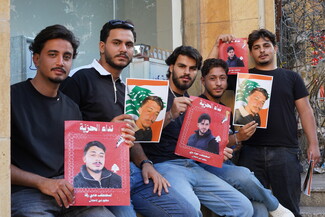
Friends of Jawad Bazzi and Hadi al-Raqqa, some of whom went with them to the South that day, demonstrate in front of Beirut’s Grand Serail. They hold up posters of their friends that read: “Call for Freedom.” Riad al-Solh Square, Downtown Beirut. June 24, 2026. (Lylla Younes/The Public Source)
Four Lebanese men vanished in southern Lebanon when they went to check on their villages on June 14, 2026. At least 37 Lebanese nationals are being held by Israel, according to the Lebanese Association of Prisoners.
On June 26, Lebanon, Israel, and the U.S. signed a framework agreement in Washington — only Clause 13 of which mentions the abductees. While the agreement itself has been criticized widely, Clause 13 has drawn specific criticism from the NHRC and Call for Freedom, who argue the agreement effectively mortgages the abductees’ freedom to Israel.
As of publication, Jawad Bazzi, Hadi al-Raqqa, Mohammad Hassan, and Ali Qashmar remain missing.
Read “Families Rally for Abducted Relatives Amid Fears Over New Framework Agreement” to learn more about how the trilateral agreement framework sidelines Lebanese abductees.
June 24, 2026 Displaced Families Return to Devastated Neighborhoods South Lebanon
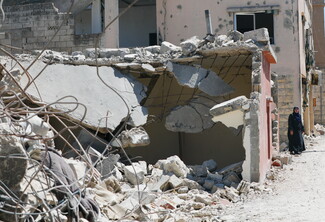
Tebnine, Bint Jbeil, South Lebanon. June 24, 2026. (Marwan Bou Haidar/The Public Source)
As the U.S.-Iran MoU facilitates the return of some residents to their towns and villages, southerners are witnessing their neighborhoods in ruins for the first time.
Families returning home after months of displacement are finding their homes reduced to rubble and entire streets unrecognizable.
Photojournalist Marwan Bou Haidar documents the scale of destruction in Srifa, Bir el-Salasel, and Tebnine in “Displaced Families Return to Devastated Neighborhoods.”
June 4, 2026 “A Unilateral Ultimatum”: Reading the June 3 Ceasefire Framework Washington, D.C.
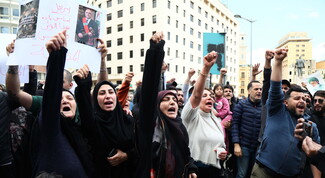
Protestors gather in support of Hezbollah at Riad al-Solh Square. One participant holds a sign that reads, “Israel is the reason for this country's hardship, not the resistance.” Downtown Beirut, Lebanon. April 9, 2026. (Marwan Bou Haidar/The Public Source)
On June 3, the U.S. State Department released a joint statement by the U.S., Lebanon, and Israel outlining a framework for ending hostilities between Israel and Lebanon.
The framework centers on a series of commitments by Lebanon, including a “complete cessation of Hizbollah fire and the evacuation of all Hizbollah operatives from the South Litani Sector” and the “creation of pilot zones in which the Lebanese Armed Forces will take exclusive control of the territory to the exclusion of all non-state actors.”
In a statement released later that day, Hezbollah Secretary General Sheikh Naim Qassem rejected the proposal, describing it as capitulation, and likening it to “Satan’s dream of entering Paradise.” Instead, he urged a united national front in the face of Israel’s continued aggression, calling on the government to “put an end to this farce … be stronger by rallying all your people around the choice of a sovereign state.”
In “The Reassignment of Enmity from Israel to Hezbollah,” we speak with Dr. Amal Saad, a leading scholar on Hezbollah, about the agreement’s broad political implications.
May 28, 2026 The Enemy Made My Home His Headline Beit Lif, South Lebanon
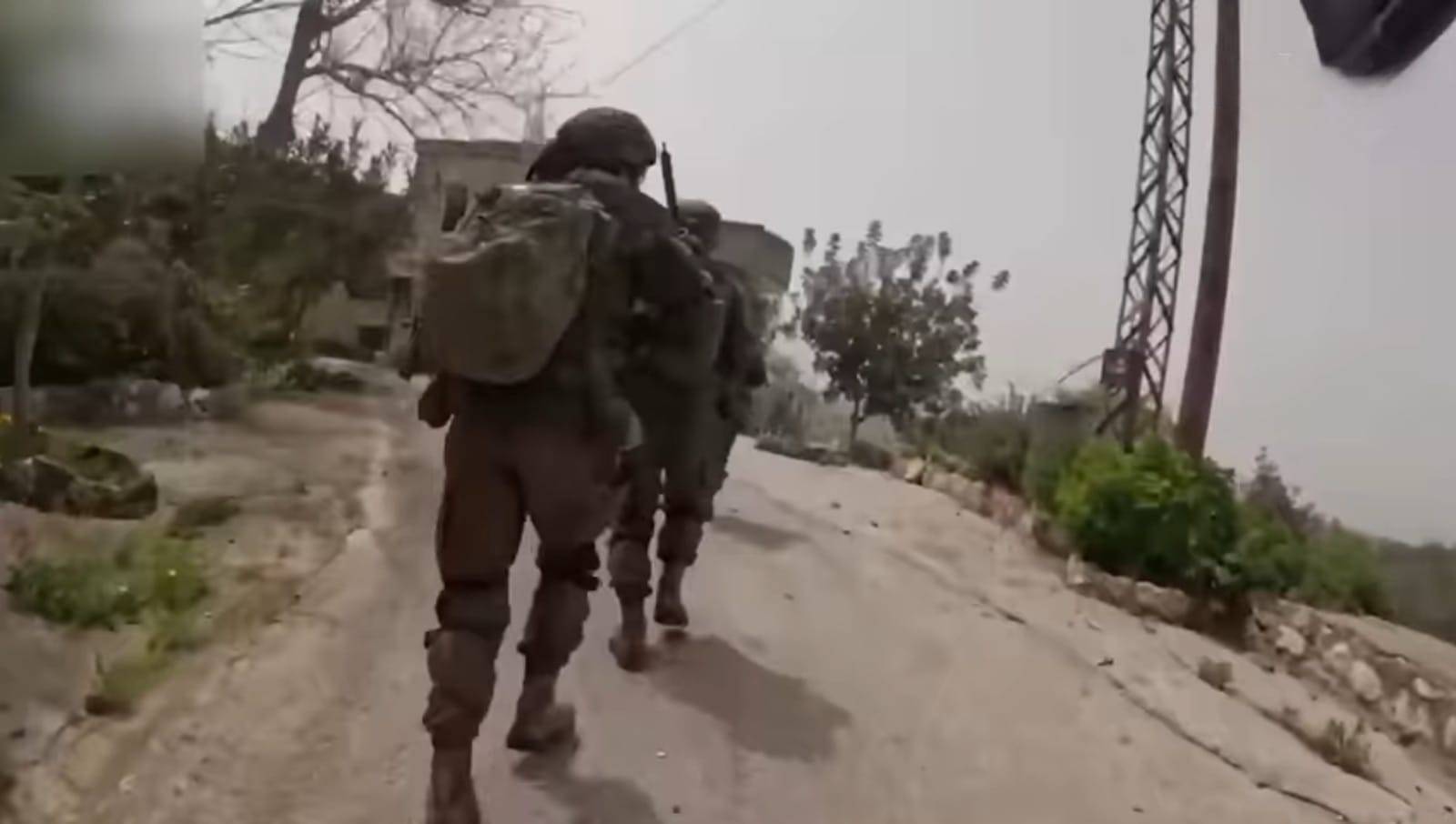
It was another evening of displacement. We had been forced out of our home and into a room that was witness to our counting the days, waiting for the return. I was sitting with my family watching the news on TV as was our habit, and this was when we saw it: our very own neighborhood appeared on the screen. The houses of the neighborhood, and among them, our home, flashed before our very eyes. The aired clip was titled “Soldier’s bodycam reveals military devices in a civilian home in South Lebanon.” And just like that, my home became a fleeting military news story. Earlier that day, a force from the Nahal Brigade had fallen into an ambush on the outskirts of Beit Lif, forcing it to withdraw.
Soon after, on April 17, 2026, we obtained an aerial photograph of the village, showing widespread destruction. Entire neighborhoods had been decimated. Our neighborhood – and in it, our home – was rigged with explosives and blown up, setting the olive and fig orchards on fire.
We knew that the enemy’s advance onto the outskirts of the town would inevitably mean entering homes and orchards and destroying them. Little did we know that they wouldn’t simply enter the house, but also film it from the inside and use it as a stage to fabricate a story, before booby-trapping it then blowing it up.
Read the rest of writer Riyasa Ismail’s account of her family home in Beit Lif being used in Israel's military propaganda narratives in “The Enemy Made My Home His Headline, and I Watched Him Roam Every Corner.”
April 14, 2026 Days After “Black Wednesday”, the Search for the Missing Continues Lebanon
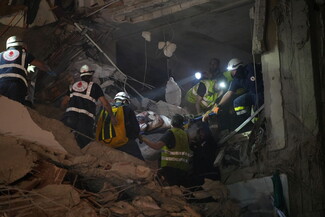
Rescue workers carry a man on a stretcher as they search for people trapped under the rubble after an Israeli airstrike on a building in Tallet el-Khayyat, Beirut. April 8, 2026. (Marwan Bou Haidar/The Public Source)
“When the bombing ended, even excavators couldn’t get in — they kept getting tangled in the wires,” said an eyewitness in Hay el-Sellom, a densely packed neighborhood where buildings are pressed tightly together and electrical wires crisscross overhead.
The eyewitness, who runs a shop in the neighborhood, described the blast as deafening, with smoke quickly engulfing the streets. He put his 2-year-old child on a motorcycle and took him to safety before returning to help. What he found was widespread devastation: “rubble on top of rubble.” Several sites were struck at once: three buildings near the al-Ghadir River, one near the Arab Mosque, and another near Arweh Junction.
The Israeli military had launched a sweeping bombing campaign across the country.
The Health Ministry initially reported 87 killed; by Friday, the toll rose to 357 as rescue teams and volunteers worked around the clock to recover bodies. As of Monday, the Disaster Risk Management Unit reported eight people still missing in Beirut, including one child.
In “Minutes of Israeli Strikes, Days of Searching for the Missing,” read about how hospitals are straining under mass casualties as families search for the missing and rescuers continue to pull bodies from the rubble.
April 9, 2026 Dozens Rally Against Normalization With Israel Riad al-Solh Square, Beirut
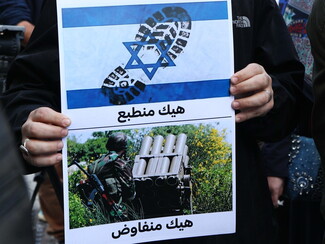
A demonstrator carries a sign that reads: “This is how we normalize” and “This is how we negotiate.” Riad al-Solh Square, Beirut. April 9, 2026. (Marwan Bou Haidar/The Public Source)
Dozens gathered in Riad al-Solh Square, facing the Grand Serail, on Thursday at 2 p.m. in protest of Lebanon’s cabinet decision to enforce army authority by disarming the resistance. Organizers declared that “the issue is no longer just posts, but a matter of dignity and existence,” adding that they cannot watch the massacres behind screens, and stressing that the blood of martyrs compels the masses to hold those in power accountable.
Demonstrators chanted against Prime Minister Nawaf Salam, calling him a “Zionist” after his announcement of the cabinet’s decision. They accused the government of failing to protect its citizens.
The mobilization came a day after a barrage of Israeli airstrikes across the country killed at least 303 people within minutes, with rescue efforts still ongoing. Protesters vowed: “We will not remain silent after today.”
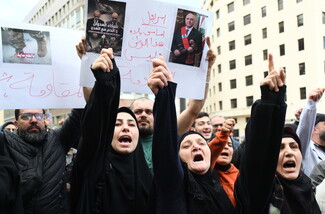
Demonstrators chant in front of a sign that reads: “Israel is the reason for this country's hardship, not the resistance.” Riad al-Solh Square, Beirut. April 9, 2026. (Marwan Bou Haidar/The Public Source)
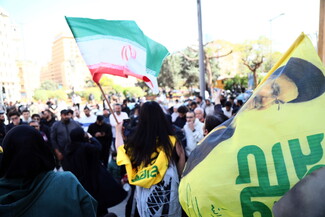
Demonstrators carrying the flag of Iran, among other flags at the protest. Riad al-Solh Square, Beirut. April 9, 2026. (Marwan Bou Haidar/The Public Source)
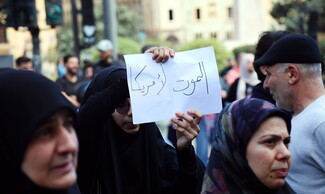
A demonstrator holds up a sign that reads: “Death to America.” Riad al-Solh Square, Beirut. April 9, 2026. (Marwan Bou Haidar/The Public Source)
April 8, 2026 Israel Kills 28 Journalists in Lebanon Since October 2023 Lebanon
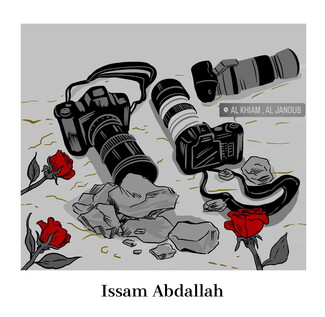
An illustration of the moment journalists put their cameras on martyred journalist Issam Abdallah's grave during his funeral in his home town of Khiam, South Lebanon. October 14, 2023. (Illustration by Amy Chiniara/The Public Source)
The Public Source has been documenting attacks on journalists since the start of the war in October 2023 and we will be continuously updating this page until the end of the U.S.-Israeli war on Lebanon.
As of April 8, almost half of the 28 martyred journalists have been directly targeted by Israel.
Visit “Media Martyrs: A Record of Lebanon’s Fallen Journalists” to read about all of the journalists Israel has killed.
April 8, 2026 Israeli Fire Belt Across Lebanon Kills Hundreds in Minutes Lebanon
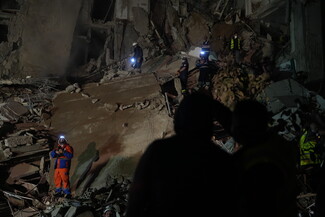
First responders carry out a search and rescue operation at the site of Israel's nighttime raid on a building in Tallet el-Khayyat, Beirut. April 8, 2026. (Marwan Bou Haidar/The Public Source)
Early Wednesday, the U.S. and Iran announced their respective acceptance of a two-week ceasefire agreement, conditional on Iran reopening the Strait of Hormuz, and the U.S. accepting Iran’s 10-point plan as a framework for negotiations, which includes the end of the war on “all components of the Axis of Resistance,” among other things.
Despite Lebanon’s inclusion in the agreement, Israel launched a series of strikes across Lebanon on Wednesday afternoon, targeting residential neighborhoods in Beirut, its outskirts and suburbs, south Lebanon, Baalbek, and the Bekaa-Hermel region.
Israeli occupation forces carried out more than 100 strikes across the country in about 10 minutes, the Israeli military’s Arabic-language spokesman said in a post on X, describing it as its largest attack since March 2, 2026. At least 254 people have been killed as a result, and 1,165 others have been wounded, according to Lebanon’s Health Ministry.
In “Wave of Israeli Strikes Across Lebanon Kills Hundreds in Minutes,” read about the aftermath of the ceasefire agreement, Israel’s continued attacks, and the martyrs.
March 31, 2026 Lebanon’s Intellectual and Cultural Front Rallies for National Resistance Riad al-Solh Square, Beirut
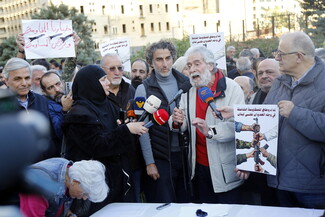
Former militant Georges Abdallah participates in the rally for a comprehensive national resistance and gives a short speech to the crowd. Riad al-Solh Square, Beirut. March 31, 2026. (Marwan Bou Haidar/The Public Source)
Lebanese academics, journalists, artists, and activists held a protest on Tuesday in Beirut’s Riad al-Solh Square to call for a comprehensive national resistance to Israel’s continued aggression on Lebanon.
The rally was called for after the organizers started a petition titled “The National Call for Comprehensive Resistance in the Face of the Aggression on Lebanon” on March 16, signed by more than 550 people. Among the signatories is the late journalist Fatima Ftouni, killed in a targeted Israeli attack alongside colleagues Ali Shoeib and Mohammad Ftouni on March 28.
Participants and speakers included recently freed former militant Georges Abdallah, MP Elias Jrade, and rapper Jaafar Touffar. Many university professors also took part, notably co-organizer and AUB professor of chemical engineering Dr. Kassem Ghorayeb, LAU media and journalism professor Dr. Jad Melki, and Middle East history professor Dr. Hicham Safieddine.
Read ‘“We Will Not Compromise. We Will Resist”: Lebanon’s Intellectual and Cultural Front Rallies for National Resistance’ to learn the organizers’ demands.
March 29, 2026 Lebanon Mourns Slain Journalists Ali Shoeib and Fatima Ftouni Choueifat, Dahieh
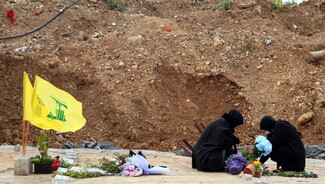
Mourners bring flowers to a grave in a mass cemetery in Dahieh, where media workers Ali Shoeib, Fatima Ftouni, and Mohammad Ftouni, were buried. Rawdat al-Imam al-Sadek temporary cemetery, Choueifat, Dahieh. March 29, 2026. (Marwan Bou Haidar/The Public Source)
Hundreds gathered at the Rawdat al-Imam al-Sadek temporary cemetery in Choueifat for the funeral of journalists Ali Shoeib, Fatima Ftouni, and her younger brother, cameraman Mohammad Ftouni on the morning of March 29.
Mourners wailed in grief under heavy rain and chanted, “Death to Israel! Death to America!”
A day earlier, on March 28, Israel assassinated Al Manar’s Ali Shoeib, one of Lebanon’s most prominent journalists, and Al Mayadeen’s rising star Fatima Ftouni, alongside Ftouni’s younger brother, freelance videographer Mohammad. Israeli airstrikes targeted their vehicle on the Kfarhouna road near Jezzine.
Learn more about the lives and careers of the courageous martyrs in “The Voice of the South and the Witness on the Frontline, Silenced by Israeli Attack on Journalists.”
March 18, 2026 Veteran Journalist Mohammad Sherri Killed by Israel Zuqaq al-Blat, Beirut
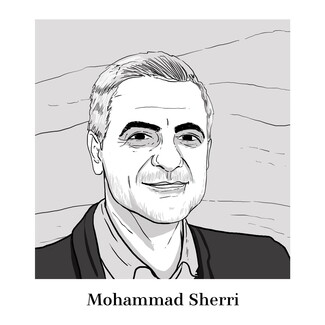
(Illustration by Amy Chiniara/The Public Source)
On Wednesday, March 18, 2026, at around 1:30 a.m., Israeli occupation forces targeted a building in Zuqaq al-Blat, deliberately killing Al Manar political programs director and veteran anchor Mohammad Sherri and his wife. The two are among 12 people killed in airstrikes that struck multiple parts of Beirut, starting at 1:30 a.m. and continuing into the early morning hours.
Sherri’s killing is part of a systemic campaign to target Hezbollah socially and politically as much as militarily — a directive that Israel has intensified since the war began in October 2023. Not only does the Zionist entity go after journalists as an attempt to suppress the documentation of its own crimes, it specifically assassinates media workers who align themselves with Hezbollah and the Lebanese resistance. Targeting these civilians is an attempt to silence the voices that connect the military front with the popular base of the resistance.
Since October 13, 2023, Israel has killed 22 journalists and media workers in Lebanon. Read on to learn about them.
March 18, 2026 Rising Food Prices Expose Government Neglect Hamra, Beirut
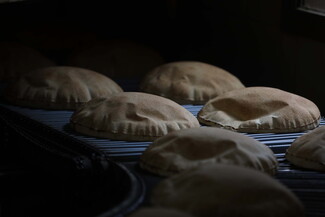
March 31, 2022. (Marwan Tahtah/The Public Source)
The increases in the cost of basic goods over recent weeks have already exceeded the 15 percent national food inflation rate recorded for the entire previous year. In the absence of comprehensive official data, market conditions suggest a far more volatile reality — one in which a year’s worth of inflation appears to be unfolding in a matter of days.
Today, at least 1 million displaced people in Lebanon face the frightening prospect of acute food insecurity. The combined pressure of political and economic forces is straining both households and the country's already fragile food system.
Yet the government continues to treat the situation as a logistical challenge or a temporary global shock. Instead of implementing a comprehensive emergency response, it has offered technical band-aid measures and short-term solutions that fall short of the scale of the crisis.
While billions of dollars sit behind bank vaults, the state’s refusal to meet the mounting national emergency with the urgency it demands means that, for the one million displaced, the next meal remains uncertain.
Read “Rising Food Prices and Limited Government Action Deepen Lebanon's Food Insecurity” to learn how the Lebanese government is responding to rising food insecurity.
March 14, 2026 Minutes of Strikes, Days of Loss Hay el-Sellom, Dahieh
“When the bombing ended, even excavators couldn’t get in — they kept getting tangled in the wires,” said an eyewitness in Hay el-Sellom, a densely packed neighborhood where buildings are pressed tightly together and electrical wires crisscross overhead.
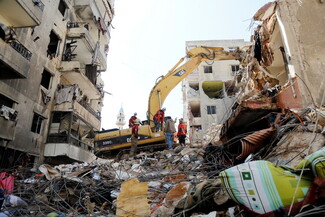
Rescue workers carry out rescue operations at the site of an Israeli strike in Hay el-Sellom, Dahieh. April 10, 2026. (Marwan Bou Haidar/The Public Source)
Located in Beirut’s southern suburbs, Hay el-Sellom had been considered relatively safe throughout the U.S.-Israeli war on Lebanon. It was not included in displacement orders issued by the Israeli military, so markets remained open and people continued moving throughout the area during the day.
The eyewitness, who runs a shop in the neighborhood, described the blast as deafening, with smoke quickly engulfing the streets. He put his 2-year-old child on a motorcycle and took him to safety before returning to help. What he found was widespread devastation: “rubble on top of rubble.” Several sites were struck at once: three buildings near the al-Ghadir River, one near the Arab Mosque, and another near Arweh Junction.
The strikes came hours after the United States and Iran agreed to a temporary ceasefire and the launch of negotiations in Islamabad on April 10. The 10-point plan presented by the Islamic Republic included a ceasefire in Lebanon as a precondition for negotiating with the U.S., raising cautious hope through much of the country.
That hope was shattered the next day, when the Israeli military launched a sweeping bombing campaign across the country, striking more than 100 locations in about 10 minutes.
March 13, 2026 Israel’s Psychological Warfare Reaches Beirut Barbour, Beirut
On Friday, March 13, as part of the psychological warfare Israel is waging against Lebanon, Israeli occupation forces dropped leaflets over Beirut, including the neighborhoods of Hamra, Verdun, Mar Elias, and Barbour, calling on residents to disarm Hezbollah. The leaflets implicitly warn that so-called evacuation notices — which are in effect forced displacement orders — and bombardment will follow if the group is not disarmed, and urge residents to share intelligence with Israel through scannable QR codes.
“If you want to be part of real change and contribute to the prosperity and protection of your country, we are here to listen,” the leaflet reads, followed by two QR codes.
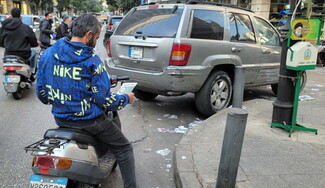
Leaflets dropped on Souk el-Dahab by the Israeli military. Barbour, Beirut. March 13, 2026 (The Public Source)
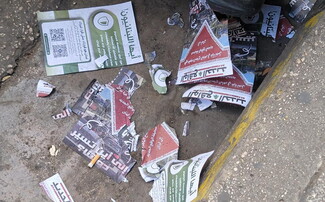
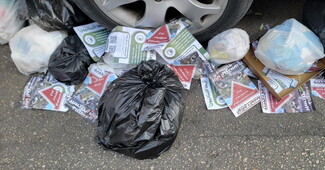
The leaflets also feature a mock newspaper design on the back, titled “The New Reality,” claiming it has reached Beirut after “resounding success” in Gaza, with the headline: “Where is our country heading?”
The front of the leaflets claims that Unit 504, an Israeli military intelligence unit, is working to “ensure Lebanon’s future,” and asks Lebanese citizens to join the effort by scanning a QR code. Unit 504, formally known as the Human Intelligence Division, conducts clandestine operations and has been repeatedly accused of torturing prisoners of war. It is also tasked with recruiting collaborators.
Read “From Leaflets to Digital Tools: A Brief History of Israeli Psychological Warfare” to learn more about this tactic.
March 12, 2026 Rapper Arrested After Criticizing Wartime Leadership Dohat el-Hoss, Aley
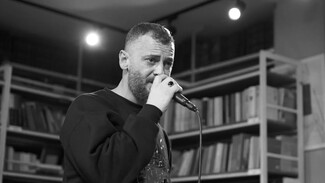
Rapper Jaafar Touffar performs at Barzakh Bookshop & Café in Hamra during a rap and ‘ataba night. February 6, 2026. Beirut, Lebanon. (Photo Credit: Jaafar Touffar's Facebook page)
Lebanese military intelligence arrested rapper Jaafar Touffar on Tuesday after he criticized the country’s president and prime minister over their stance towards the U.S. and Israel amid escalating Zionist violence in southern and eastern Lebanon.
“What kind of state are you talking about, Mr. President?” Touffar rhymed in the video he released shortly before his arrest. “A state bending over to the Americans and sucking up to the Israelis? This is Satan’s dream of paradise.”
He also challenged the government’s policies during Israel’s ongoing aggression, adding: “Is it in the state’s interest to order its army to flee while a war rages on its borders? Or for its people to be exterminated while its prime minister behaves like a thickheaded fool?”
Read, “Rapper Arrested After Criticizing Leadership’s Wartime Conduct” to learn more about his case.
March 11, 2026 “We’re Broken”: A Testimony of Displacement From Alma al-Shaab Alma al-Shaab, Sour

Father Maroun Ghafari on the phone in the hall of the St. Mary Church in Alma al-Shaab, where the town residents have been sheltering since Wednesday, March 4. March 9, 2026. Alma al-Shaab, South Lebanon. (Photo courtesy of Rana Farah)
On March 10, Israeli occupation forces called the mayor of Rmeish, a Christian-majority border village, in an attempt to compel the villagers into collaborating with the occupation: “We see you as friends and family. We don’t want you to bear the brunt of those who are trying to destroy Lebanon. Understood?”
Evidently, however, there are no “good neighbors” for an expansionist entity. On March 9, the Israeli occupation hit the Christian town of Qlayaa with a double-tap strike, killing the local parish priest Father Pierre al-Rahi. Qlayaa Mayor Hanna Daher denied claims that Hezbollah fighters were in the village.
We spoke to Rana Farah, a 37-year-old school administrator and a native of Alma al-Shaab, a small town located on the southernmost Lebanese border. She was one of many in her village who refused to leave despite continued Israeli bombardment and an Israeli order to evacuate.
We first contacted her on March 5 when she and others were sheltering at the St. Mary Church, then followed up with her after everyone was forced to leave the village with a UNIFIL escort on March 10.
Read “‘We’re Broken’: A Testimony of Displacement From Alma al-Shaab” to hear Farah, in her own words, describe what it means to stay when the enemy is threatening you to leave.
March 8, 2026 Beirut Marches for the Displaced: “The Lebanese State Must Shelter Its Own” Hamra Street, Beirut
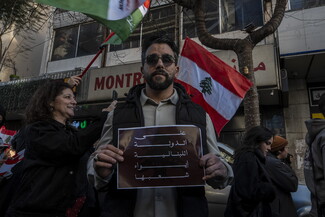
A survivor of the Israeli pager attack, Mohamad Halawi, participates in the protest. Hamra Street, Beirut. March 8, 2026. (Fatima Joumaa/The Public Source)
On March 8, protesters marched through Hamra Street in Beirut, chanting in support of the resistance and demanding the Lebanese government do more to assist the hundreds of thousands displaced by Israel’s relentless assault on Lebanon. The demonstration was organized by a collective of media professionals and journalists who align themselves with the Axis of Resistance.
“Where will they go?” Khalil al-Zain, a mukhtar in the city of Sour, told The Public Source. “People with big families and those who don’t have the means to flee will tell you that it’s more honorable for them to die at home.”
Read “Beirut Marches for the Displaced: ‘The Lebanese State Must Shelter Its Own’” to learn more.
March 6, 2026 Voices of Defiance Against Israel’s Assault on Lebanon Riad al-Solh Square, Beirut
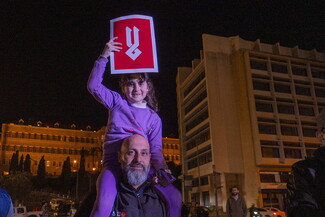
A demonstrator carries his young daughter on his shoulders. She is carrying a poster that reads: “No.” March 6, 2026. Riad al-Solh Square, Beirut. (Fatima Joumaa/The Public Source)
Dozens gathered in Beirut’s Riad al-Solh Square on the evening of March 6 to protest Israel’s ongoing aggression against Lebanon and the forced displacement of residents across the South and Beirut.
One demonstrator, carrying his young daughter, told Al-Akhbar newspaper, “We are staying, and we will remain, and we will teach our children that this is our country and that we will persist, despite the difficulties.”
Read “Voices of Defiance Against Israel’s Assault on Lebanon.”
March 5, 2026 Israeli Occupation Orders Forced Displacement for All of Dahieh Dahieh

On March 5, 2026, Israeli occupation forces issued a forced displacement order to all residents of Beirut's southern suburbs, threatening the lives of around 700,000 people. (Map by Ahmad Baydoun/The Public Source)
Earlier today, the Israeli occupation forces issued a forced displacement order to all the residents of Dahieh, threatening their lives if they do not leave the southern suburbs immediately.
This is the first time that such an order designates the entirety of Dahieh, along with adjacent municipalities, as a site for bombardment.
Read “Israeli Occupation Issues Forced Displacement Order for All of Dahieh” to learn more about Israel's displacement orders across Lebanon.
March 1, 2026 Thousands Gather to Mourn Ayatollah Khamenei Haret Hreik, Dahieh
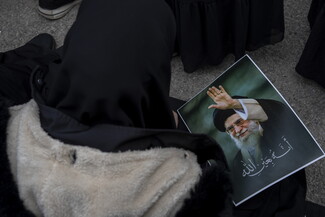
A tired woman quietly bows her head as she rests on the ground. A photograph of Khamenei waving sits in her lap. It reads: “It is under God’s watchful eye.” Ashoura Square, Dahieh, Lebanon. March 1, 2026. (Fatima Joumaa/The Public Source)
Thousands of Resistance supporters in Lebanon wept and swayed to Hussaini lamentations at a gathering in Dahieh’s Ashoura Square on Sunday, March 1 to mourn Iran’s Supreme Leader Ayatollah Sayyed Ali Khamenei.
Fasting crowds of mourning men, women, children, and the elderly — all clad in black — marched toward the square from the early morning hours. They carried pictures of Khamenei in their hands and pressed to their chests, joined in chest-beating rituals, raised Hezbollah and Iranian flags, and chanted: “Far from us is humiliation.” By 4 p.m., Jamous Street was nearly impassable. The sound of weeping moved through the gathering to the backdrop of the hymn, “Farewell, Our Father.”
Among the women, one voice soared above the others: “Stop your wailing and praise God from the depths of your hearts, with all your strength. We will be victorious; we will break their power.” She then chanted, “Death to Israel and death to America” — a slogan repeated by those around her.
Read more about the late Ayatollah and see photos of his farewell in Lebanon in, “Lamentations for a Fallen Leader: Thousands Gather to Mourn Ayatollah Khamenei.”
Share this page